A Plague Tale: Innocence is a stark contrast to Asobo Studio’s prior work, which includes titles based on family-friendly movies such as WALL-E, Toy Story, or Garfield. Even contemporary games could not be more different. Today, Asobo Studio is best known for the A Plague Tale games and Microsoft Flight Simulator. What sets A Plague Tale: Innocence apart from the rest of the lineup is its extremely dark and gritty medieval fantasy setting. The game does not hold back on heartbreaking moments and gory visuals. But it is not a horror game at heart. A Plague Tale: Innocence is a linear, story-driven adventure with a focus on stealth and occasional combat. It borrows elements from survival horror titles, such as exploring the world for supplies to aid in your journey. The major difference is that resources are plenty enough to get you through all situations. If a puzzle requires a certain amount of crafting materials, you can generally find them near its location. This design choice makes the game very approachable, and the primary reward for exploration is a healthy surplus of resources for lavish use and upgrading the main character’s gear.
A Plague Tale: Innocence’s game design is a puzzle at its core. But it does not present itself as a puzzler. Your journey through the 17 chapters confronts you with carefully crafted areas populated with enemies of varying types. Depending on the enemy and the gear you have unlocked, you can take out your foe or, most of the time, distract them to sneak past. After all, the main protagonist is a fifteen-year-old girl usually accompanied by even younger children, her five-year-old brother in particular. One hit instantly spells game over. A slow and methodical approach is typically the key. When you combine the dark story and atmosphere, the game creates a suspense-packed gameplay experience.
For the most part, A Plague Tale: Innocence is not very difficult. Because of its linear structure and limited size, the solution to crossing an area is usually not difficult to deduce. Only in the later chapters does the number of enemies in a particular location provide a challenge. Until then, A Plague Tale: Innocence is more about engrossing you in its story, world, and characters. The successor, A Plague Tale: Requiem changes that and unleashes you into larger, much more challenging places. But that does not mean that A Plague Tale: Innocence is a walking simulator. There is enough gameplay here to make it a proper and exciting game. Asobo Studio created a very focused adventure without unnecessary fluff and monetization crap.
(Stay away from the Coats of Arms DLC, though. From what I saw, this is a pack of “outfits” that merely change the color of the base outfit, which you’ll never see again after the second or third chapter.)
Story & Characters
A Plague Tale: Innocence takes place in France at the end of the 1340s. You play as Amicia, the fifteen-year-old daughter of a noble family. The adventure starts in an idyllic forest when Amicia wants to relive a childhood memory with her father – shooting apples off a tree using a sling. However, the game does not waste any time in this tutorial chapter until events turn sour. After everything is said and done, Amicia and her estranged brother Hugo are orphans hunted by the Inquisition. And if that weren’t enough, a sudden rat plague infests the lands, posing an additional threat to the two children. And on top of that, Hugo has an unknown disease which their mother tried to cure with the help of the doctor and alchemist Laurentius. Her last wish was for Amicia to take her brother to him since he would know what to do. From this point on, Amicia is left to her own devices while trying to understand why the Inquisition raided her home and taking care of a little kid she has barely seen because of his illness.
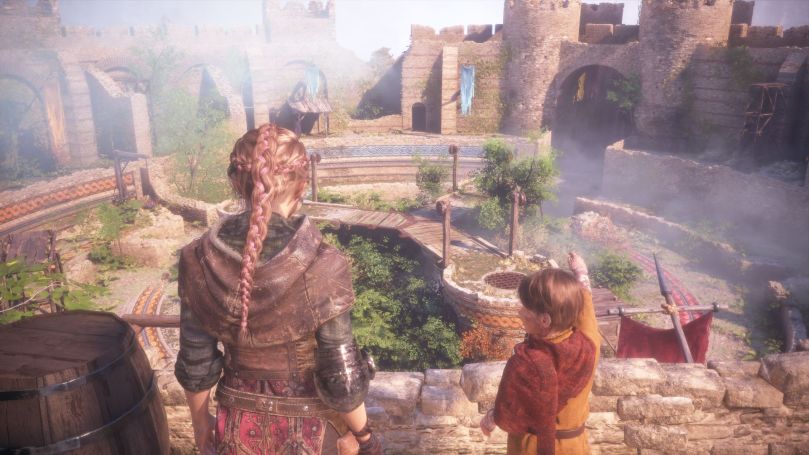
Navigating the situation, Amicia and Hugo start developing a bond. Amicia slowly becomes the big sister, protecting her little brother with all her might. In some aspects, it is similar to Joel and Ellie in The Last Of Us. A Plague Tale: Innocence is as much about the intriguing story of the rat plague and Hugo’s mysterious illness as it is about family, friendship, and loss. Asobo Studio never pulls any punches just because the main cast is a group of kids. Not even dogs are safe 😱. But because the characters are well-written, the events that unfold feel a lot more impactful than in another infamous game I played last year.

Despite the very different setting, I recognized some similarities between A Plague Tale and the legendary misadventure that was Dragon Age The Veilguard. Both broach the issue of a widespread infestation that a rag-tag group is trying to deal with. However, there is an enormous chasm in quality and tone. A Plague Tale: Innocence is so much more mature and serious in writing and its visuals. It foregoes the witty, smartass dialog but still manages to retain genuine lighthearted moments for a brief relief of tension. Not so Dragon Age and, as such, its tragic moments did not feel as sad as they should have. This is a non-issue in A Plague Tale: Innocence. It is a level of quality gamers would have expected from veteran storytellers, such as BioWare.
Gameplay
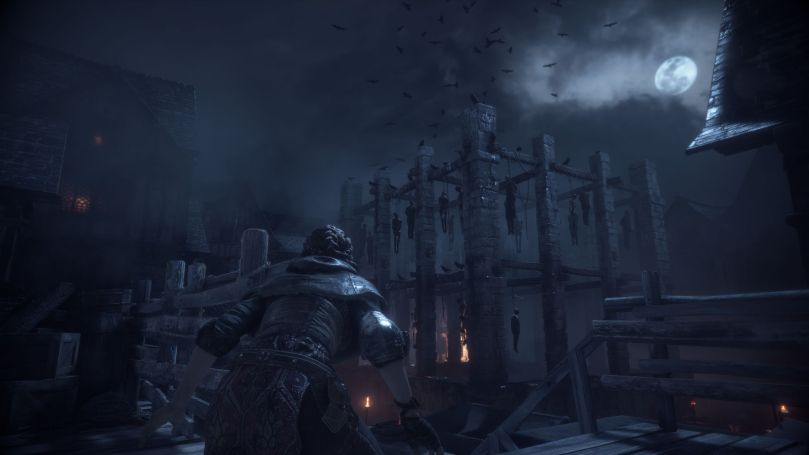
As I mentioned earlier, A Plague Tale: Innocence is mainly a stealth game. You can decide to initiate combat, and sometimes, the game even makes that decision for you in setpiece moments. However, the goal is to stay hidden and avoid conflict. Amicia does not have a health bar, and it takes only one hit for her to go down. If she is spotted, the best course of action is to outrun the enemy and hide or hope they are unarmored and she can take them down with a rock at high velocity to the head.
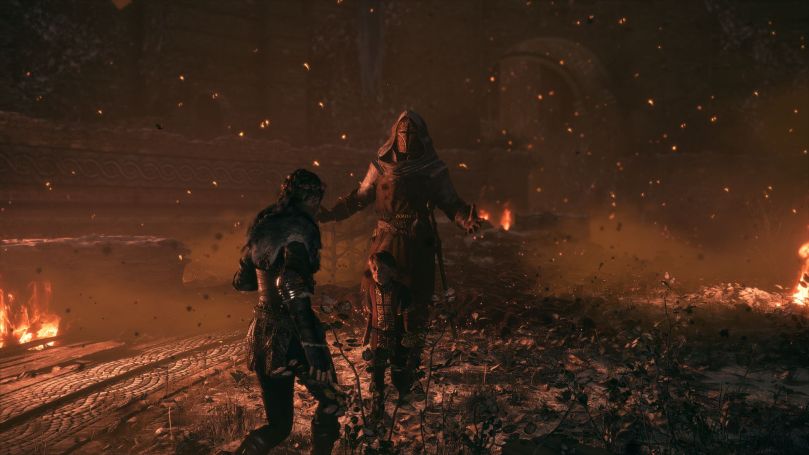
Her weapon of choice is a sling, and the primary ammunition is said rocks. As the game progresses, Amicia learns alchemist tricks to combine crafting resources to ignite fires, create explosions, or force soldiers to take off their helmets, to name just a few. Armed with these skills, Amicia can distract enemies or attack them. But attacks only work on human foes. The rats, on the other hand, are vast in numbers and only react to light. Asobo Studio uses this idea for additional suspense and to make light a crucial but also scarce resource to handle. There are torches all around the different chapters that serve as a place to gather yourself and also guide the way. However, this system is also so incredibly game-fied that it requires a lot of suspension of disbelief.
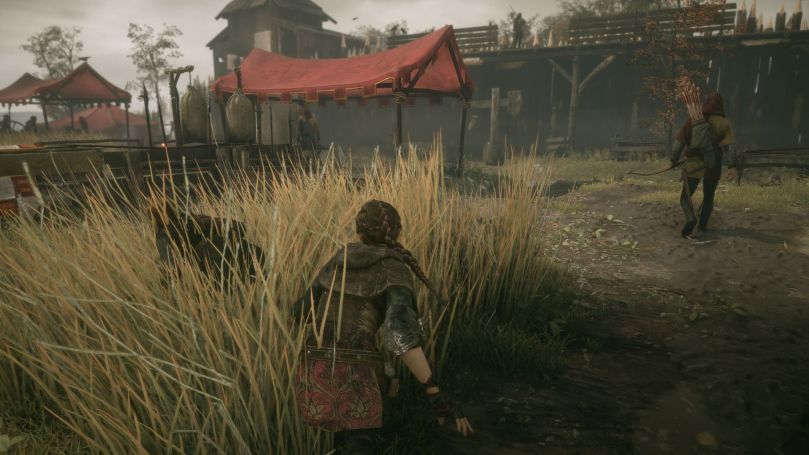
You would think that someone would do everything in their power to hold on to a torch if it were the deciding factor between life and death. A Plague Tale: Innocence is a bit rigid in its game design, however. Amicia and her companions must vault over obstacles or climb on a ridge in some areas of the world. She cannot do that while holding a torch. Luckily, there are convenient sconces nearby to place the torch. But once Amicia is past the obstacle, no matter what it is, she cannot reach back to fetch it. She’s also unable to give it to her companions for the time being and then get it back.
Another example is bushes of dried wood from which Amicia takes exactly one stick to light in a fire and then walks away – slowly. The sticks of wood do not burn forever, of course, as it makes sense. What does not make sense is the fact that Amicia only ever takes a single stick of wood instead of as much as she can reasonably carry. Sneaking right past human enemies or hiding basically in front of them behind a regular table are more examples of things you should not think too much about with a logical mind. It is a well-made, entertaining game with a few quirks that would fail any reality check.
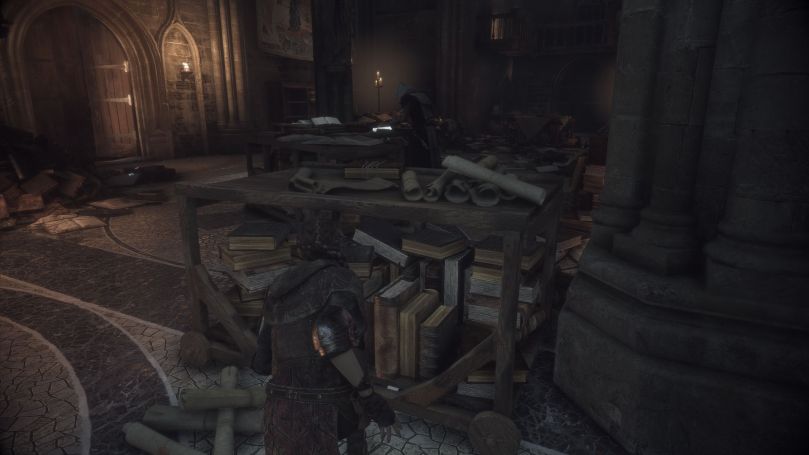
The size of the areas Amicia and her friends traverse is very manageable. Only a few levels have diverging paths you can choose as a player. The level design is generally linear, and the only reason for wandering off the beaten path is to find collectibles and crafting materials. The collectibles are nicely integrated into the story and trigger a brief moment with a companion or elicit a comment from Amicia. They are not important for the story or player progression, but add a nice touch of humanity to the otherwise dark and bleak world.

The Nerdy Bits
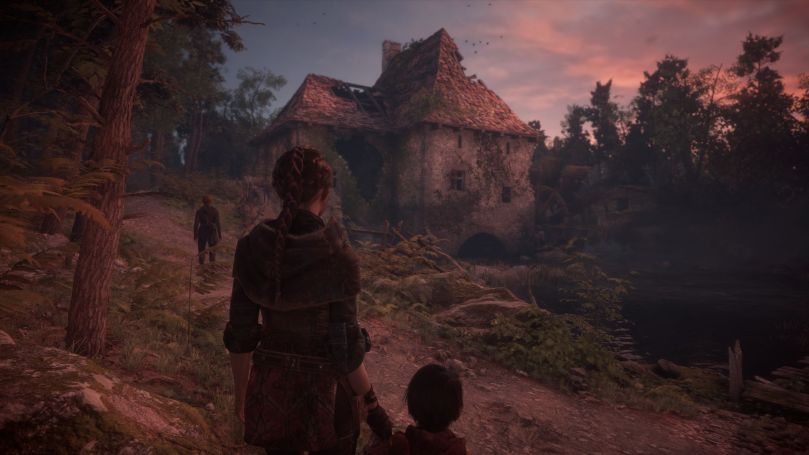
Asobo Studio developed their own tech for A Plague Tale: Innocence, and it is pretty good, even today. The developers and level designers created locations that feel dense and full of odds and ends. Forests are lush with trees and flowers. Town areas or castles are littered with all kinds of detail to make them appear realistic and lived-in. Characters and their clothing look good and full of intricate details. The biggest standout is the swarms of hundreds of rats present on screen at any time. Overall, the game’s tech can render a beautiful, colorful world and dark, organically overgrown, and collapsed environments.

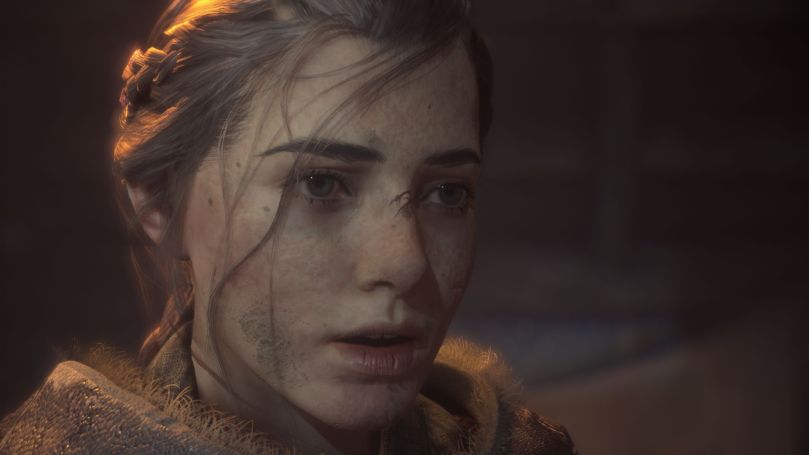
The only weak points are character faces and their facial animations. Faces appear stiff and unable to convey emotions properly. To draw another comparison to a contemporary game, the quality of the expressiveness of characters is not too far behind Star Wars Outlaws, a game from 2024. But even if this sticks out as a flaw, it does not ruin the game in any way. You are mostly looking at your character from a third-person perspective anyway.
Another thing I noticed is what looks like screen-space ambient occlusion. If you have an eye for such things, you will occasionally notice ambient shadows drawn in front of your character as you move through the game world.
And since it is no Unreal-powered title, none of the common issues plague the enjoyment of this tale.
(See what I did there?)
That means no incessant traversal stutters or shader compilation frame spikes try to ruin the smoothness of a sea of rats. There was the odd loading stutter on occasion, but those were very few and far between. This is a well-running game. At the same time, I am running a title from early 2019 on hardware from late 2022 to early 2023. I have a Ryzen 7600 paired with a Radeon RX 7900 XT.
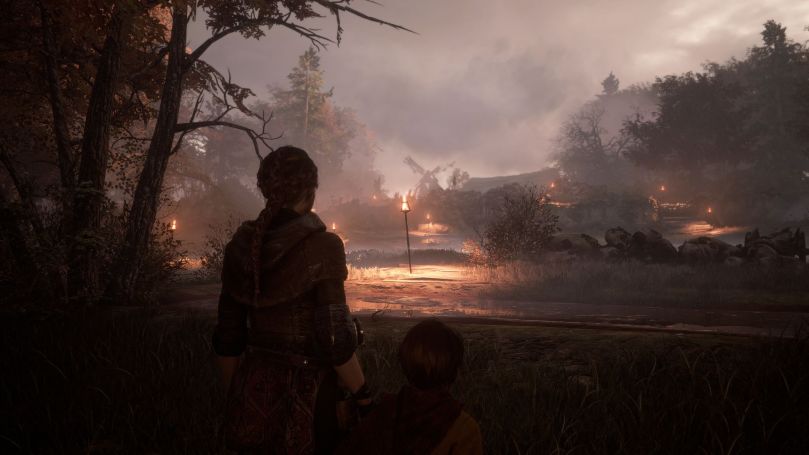
I played primarily on Linux, with a couple of chapters on Windows. The game ran flawlessly using Proton in Heroic Launcher. I used the Epic Games Store version that Epic gave away for free a while back. I have since also purchased a copy on Steam as a bundle with A Plague Tale: Requiem to feed some of my money to the developers. Here are a few benchmarks to compare the two platforms. I used the start of the second and fifth chapters and ran back and forth three times. You can take a look at this short YouTube video for the exact benchmark passes. I recorded the first on Linux and the second on Windows. Of course, the recording is not part of the benchmark numbers.
| Chapter 2 | Chapter 5 | |||
| 1% FPS | Average FPS | 1% FPS | Average FPS | |
| Linux | 154.8 | 208.1 | 172.5 | 228.6 |
| Windows | 182.8 | 212.8 | 191.7 | 222.5 |
Chapter 2 turns from GPU to CPU limited as soon as you get into the town. Chapter 5 is entirely GPU-limited. Windows is basically ahead every time, especially looking at the lower numbers. However, performance is so good that my 144 Hz display is the limiting factor on either operating system. I am running Fedora 41, and the latest kernel, as of testing, was 6.13.5.
If you are interested in a more thorough breakdown of the technology, I encourage you to read Digital Foundry’s piece on Eurogamer.
A Plague Tale: Innocence is not just about its visual presentation. The sound design and music, in particular, are outstanding. The rats’ shrieks are vicious and frightening, and the music… The music is so good. The composers stayed true to the time period and relied heavily on string-bowed instruments to capture the dark atmosphere and generate tension. The music is simply perfect.
The same goes for the voice acting. All actors and actresses bring their characters to life. Kids really sound like kids, unlike in the Witcher games, where I always had the impression that young adults talk with an unnaturally high pitch to emulate the voice of a young child. The only time I noticed that this game was not made with a AAA budget was the reuse of voice actors for different side characters. You won’t believe how many soldiers sound like Vernon Roche from The Witcher 😉.
Famous Last Words
A Plague Tale: Innocence was a surprise hit for Asobo Studio and for good reason. I initially started playing on an Xbox when it was on Game Pass. I never finished it, though, and it was one of the titles that prompted me to rant about camera control on a controller in video games. I am happy I snatched it up from Epic Games when it was free, in case I want to play on PC at some point. Because I did, and it was great. The controls with a keyboard and mouse are much better, although the gameplay would suit a controller very nicely.
None of the seventeen chapters are particularly long and allowed for short gaming sessions whenever I felt like it. The Heroic Launcher counted 10 hours and 30 minutes of gameplay, and I must add one to two hours spent on Windows. It is a short and sweet (well, more like dark) game that does not overwhelm the player with an endless sea of game mechanics or giant Open World spaces, and I liked that about it. The gameplay was engaging, although not too challenging, and the setting, characters, and story were very compelling.
I look forward to trying my hands at A Plague Tale: Requiem again.
Thank you for reading.
 The Codeslinger
[…] you are afraid of a plague of rats, I have a blog post reviewing the […]
LikeLike