I believe this is the first time that I write an introduction to a review after all has been said and done. I don’t know where to start. It is only my second Final Fantasy game, so my expectations were simple:
- A more fun combat than Final Fantasy VII Remake.
- An equally good story.
- Great visuals and music.
And all of that came to fruition. However, there is a But coming – a very stiff But.
(I better stop this metaphor before it gets out of hand.)
The technical presentation had some issues that could make side content unengaging for you despite the excellent writing. The author’s work was exceptional, and it is a shame that not all received the high-quality presentation it deserved. Did that make it a bad game? No, absolutely not! I liked Final Fantasy XVI a ton and finished it relatively quickly, given its length.
Let’s start the review before I continue beating around the bush.
The Nerdy Bits
All reviews I have seen and opinions I have heard agree that Final Fantasy XVI looks incredible and next-gen. In principle, I agree wholeheartedly. The game employs a style and technology choice that is rather unique. However, not all is unicorn and rainbows, and I will get to that. Let me begin with the good stuff.
FF XVI looked absolutely outstanding during its real-time cutscenes. Some of them were jaw-droppingly beautiful. The gameplay scales back this level of detail, of course, owing to the larger scope of what is on screen.
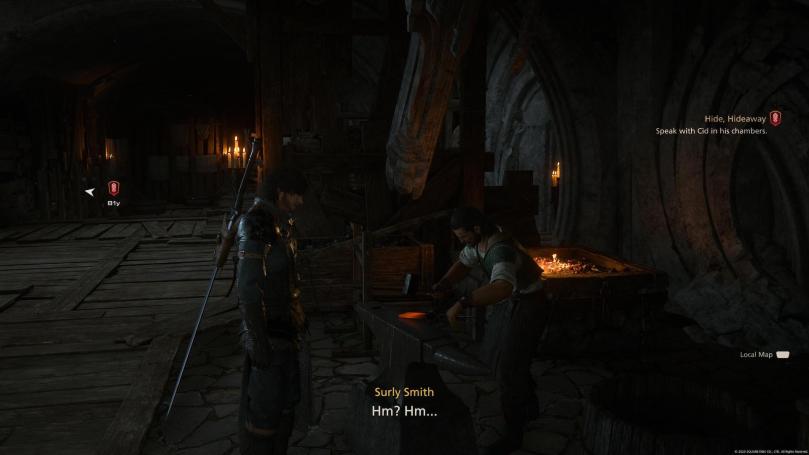
The highest-quality visual features displayed in all situations were lighting, ambient shadowing, and texture materials. Most big releases nowadays boast quality artistic lighting, and Final Fantasy XVI is no exception. Where it excels compared to many other games is the consistent quality of its ambient shadowing. This part of rendering is more important than direct shadows and is often overlooked when marketing features like raytracing. Indirect shadows (or ambient occlusion) add depth to a scene, making it more life-like and believable. I notice flat and incorrectly shaded environments and character models much more than directly cast shadows. But that does not mean that this game ignores direct shadows. Quite the opposite, in fact. Directly cast shadows also look great by implementing a convincing contact hardening effect that softens the shadow further away from the shadow-casting source. But as much as this is true and cool, I barely noticed this during gameplay. That was not where my eyes tended to focus. Or the shadows were so good that they faded into the background and became second nature. Ambient shadows, on the other hand, are immediately apparent. This screenshot of the hideout should demonstrate it nicely. It looked very believable and wasn’t even from one of the high-quality cutscenes. There weren’t any oddly glowing spots where no light should be. Ever.
This outdoor scene shows a small village in the background. Notice how accurate and coherent the image looks?

All the wooden scaffolding had correctly (un)lit dark areas, and the boards on the bridge cast subtle shadows on themselves. Character models looked equally impressive with accurate self-shadowing – without the usual weird visual glitches. I think this was an incredible achievement and one of the highlights of this title. Not to mention the whole art style and design, but that is a different discussion and totally up to one’s taste.
Fantastic lighting and shadow casting is one element of a game’s presentation, and a big one at that, as mods and releases of older titles with raytracing enhancements have impressively demonstrated. Another piece of the puzzle is texture materials. What good is wood if it does not look as it should?
(Sorry)
Essentially, all surfaces appeared like I would have expected them to: leather was leathery, with a light diffuse reflective shimmer. Wood was dry and rough, and stone walls looked cragged and gravelly. I could not find a single texture that did not imitate the real-world material properly. One of the more impressive examples was the marble throne of one of the realm’s rulers.
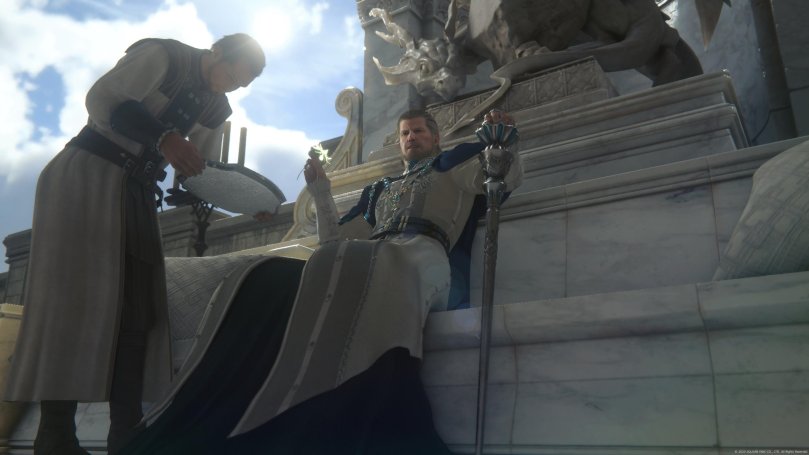
Take a closer look at the diffuse sheen on the dragon’s head. The physically based rendering of textures was impeccable and especially a looker in the game’s cutscenes. But Final Fantasy XVI also had much to offer outside of the cinematics. In many areas, particularly the important ones, the level of geometric detail was off the charts. How about this lush forest?

Or this impressively dark and atmospheric path through ruins during a raging storm?

This next forest was most likely one of the best renditions of distant trees in a video game. Look at the density and then compare it to Halo Infinite.

Oddly enough, the most astounding areas were deserted and rundown villages and castle ruins. The amount of incidental detail and small objects placed in the scenery was beautiful. And tragic. But mostly beautiful. Everything linked to the main story was that impressive. Secondary locations were only sometimes this convincing, but that was to be expected. On the surface, there was enough detail when quickly glancing over it. It was enough to be a decent facsimile, but only occasionally on the same level as the set piece moments.
Final Fantasy XVI had a dark and gritty look reflected by its color palette. Apart from the visual spectacle of combat, I rarely found vibrant art in this title. The colors were muted and closer to reality than your typical video game. I think FF16 is best experienced on an OLED TV or at least a unit with proper local dimming. The usual LCD glow weighs quite heavily on the presentation since much of the image is dark and gloomy (from experience, I talk).
But not all is nice and shiny in Valisthea. Returning to the topic of textures again, you may have noticed how flat some of them looked. The seams between the throne’s marble plates do not appear particularly three-dimensional. Or the ground in front of the bridge in the screenshot before. Although there is the occasional polygonal depth effect, textures rather often try to make up for the lack of geometry. It starkly contrasts the often insane amount of small odds and ends strewn about places. Therefore, not all environments had that dense and highly detailed next-gen look. I noticed this early in the game and did not even search for it. I entered a courtyard and thought, “Huh, this is very unimpressive” – compared to what came immediately before it.

One could argue that the structure was just withered and worn, but in the end, it was a texture trying to compensate for geometric detail that got drunk in a bar and did not make it to the game. Or how about this dirt road?

While the texture material was terrific, and the texture detail too, it can only carry a presentation so far. And that only works if the textures have a high resolution – which none really had. The whole game looked relatively soft – more on that momentarily. Some textures appeared as if they had not even loaded correctly. Take this shady dude’s garments, for example. Or the wall in the background. Or the door. While the textures have a lot of detail, the resolution is not the greatest. And it is everywhere in Final Fantasy XVI. Most of the time, the composition of a scene or the moment-to-moment gameplay covered these shortcomings, and it was still scenes like this exaggerating the sub-optimal quality.

Returning to the topic of a soft presentation, let me touch on the resolution and image reconstruction. Nobody knows precisely what the developers implemented, but John Linneman from Digital Foundry surmises it could have been FSR 1. He also presented the resolution numbers he discovered in his video. Combine that with the spatial upscaling and the aggressive default motion blur, and the end result was a very soft presentation. Until the first (and only) patch was released that would allow adjustments to the motion blur intensity, I was both in awe and often disappointed by the graphics during gameplay. After lowering the motion blur option to “1”, I was a lot more satisfied with the sharpness of the image. It could have been better, but it was serviceable enough. The art design more than made up for it.
(Just do not play in performance mode. Promise me!)
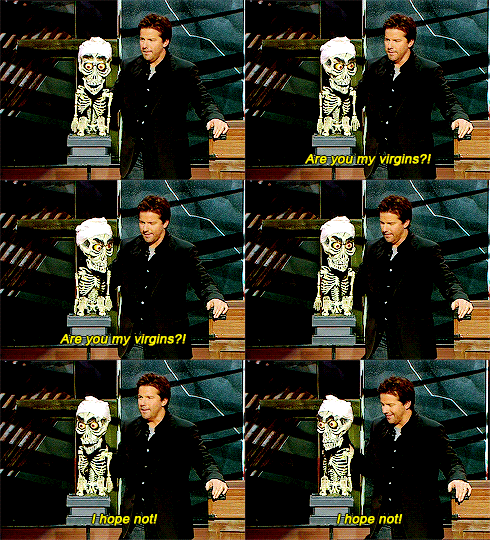
Lastly, I must reprimand whoever oversaw the character animations during dialog sequences. By that, I mean basically everything that was not one of the high-quality cinematic real-time cutscenes. If the story and the character development had not been as good as they were, this would be an absolute no-go for a triple-A 80€ production in 2023. Actually, it is a no-go. I am sorry, but I cannot think of a more stiff and unnatural performance in any of the recent games I have played. I watched a playthrough of Aliens Dark Descent recently. While the character models were not as detailed, their animations were way more natural in their gestures and portrayal of emotions. The characters in Final Fantasy XVI did none of that. It looked worse than any of the puppets in a Jeff Dunham show. Characters, even the main protagonists, barely moved, barely showed emotions, with a lip-sync that would offend the word “sync” in the most horrific way possible. It was bad, really, really bad. The only saving grace was the quality of the writing and the character moments it created. Visually, this particular aspect was not AAA-worthy in 2023.
Now, let me get back to some of the better elements of Final Fantasy XVI. Great character moments are only great if the voice acting does not fall flat. Luckily, it did not in Final Fantasy XVI. Except for a few random non-essential NPCs you might find in any game, every person playing an essential role in the story was without a flaw. I immensely enjoyed the mainly British cast of actors and their various dialects. It was a welcome change of pace from the predominantly American (no offense, I like it) voices you usually hear in games. Even Amicia and Hugo played a part, which I found pretty funny that both appeared in the same game outside of A Plague Tale.
However, I found it odd that every line in every environment sounded like it was recorded in a properly sound-treated audio booth.
(Duh…)
This meant that environments did not seem to have much effect on the presentation of the spoken word. There were instances where an echo was added to conversations, for example. But even then, it still somehow sounded wrong. For the most part, I found that the voice acting always appeared too immaculate and, as a result, had the effect of a translation voice track in a movie. This was significantly compounded by the lip sync issues mentioned earlier. Now, in many instances, it worked wonderfully. Not always, though. At the end of the day, I got used to it, of course. In contrast to the punchy and pristine voices were some of the sound effects. Swords slicing through an enemy – as in the thing you do all the time – or giant monsters roaring at the heroes were among the weakest effects. The noises of Clive’s sword were more akin to ripping an extra thin piece of paper in two instead of a massive piece of sharp metal penetrating the armor and skin of human and fictional foes alike. I would have expected something with more oomph and heft to it. Worse yet were beast-like mini-bosses. Many were introduced with fanfare to the battlefield by a dedicated brief cinematic. To top it all off and instill fear in the protagonist and player, and to mark their territory, they screamed and roared and growled. Or at least they tried. I saw their mouths opening, baring fangs and spitting fluids.

But honestly, my sister’s two kitties make more noise when they squeak.
(It is so adorable 😻)
However, giant two-story large enemies that supposedly tried to threaten me choked on the audio mix. The sound lacked any form of punch.
(Maybe the punch went to that bar with the geometric detail and got into a fight.)
What is curious about this is that the game contains powerful roaring sounds. For some reason, they were never used when beasts postured before Clive and his companions. Furthermore, FF16 relied heavily on bass, but in a way that made me turn down my subwoofer a bit. Sound effects from Clive’s powerful magic attacks deliver their oomph in the lower ranges of the spectrum, mainly ignoring the mid-range. I was not a fan of that. It was too much for my liking, but your mileage may vary. I perceived little fidelity in the presentation, neither with my 5.1 system nor my Beyerdynamic headphones. The music was fine, mind you. I am solely talking about the spectacle of combat.
I also think that the surround-mix did not provide enough (any?) positional information about enemies and their attacks. I had to rely on on-screen indicators for that. Positional audio worked, as evidenced by Torgal grunting and panting in the rear speakers when running after Clive during exploration. Maybe all of that was drowned by the bass thumping everything.
The music was good for the most part, sometimes even extraordinary. I was looking forward to it after the Final Fantasy VII Remake surprised me. Maybe I remember FF 7 Remake more fondly than it actually is if I were to play again. As it stands right now, I prefer its music over Square Enix’s latest entry.
Before I move on to the Gameplay section, I need to summarize this section because of all my negativity.
I agree with almost everything John Linneman pointed out in his Digital Foundry Tech Review. He even showed examples of the B and C-tier cutscenes, as he called them. He was more forgiving than I am, though. I have played all the side missions I found, so an enormous amount of my time was spent watching these types of cutscenes. The stark difference in quality between the real-time cinematics and the rest is really jarring. And his point of reference, Horizon Forbidden West, is also my reference and the gold standard to beat these days. FF 16 is light years away from that, and the amount of time the game subjects you to the bad cutscenes is a sore spot on an otherwise impressive, if flawed in some areas, visual presentation. I like how Final Fantasy XVI looks, with its ambient shading and lighting, the art direction, texture materials and detail, and the characters. I can forgive the texture and image resolution in the context of the environment’s overall visual style and composition. It is, without a doubt, beautiful. I am also not that bothered by individual sound effects not delivering a crushing blow to my ears. I am saying that Final Fantasy XVI wasn’t just one impressive cutscene after the other. There was more to it, and that is what I pointed out.
I hope I could put my outrage and facetious commentary into perspective. I want this game to be good. There was so much to like.
What I did not take issue with were the loading times. Final Fantasy XVI is a close second to Ratchet & Clank Rift Apart. This made getting around the world for the side missions so much more enjoyable. Otherwise, I doubt I would have bothered.
(Listen to the spoiled brat…)
Gameplay
How Final Fantasy XVI played is likely the biggest point of contention. It was a character action game focusing on a single hero. I had companions, something I always enjoyed, but only Clive was controllable. What worked very well for me was the simplicity of the gameplay. I always dread a myriad of moves and skills that result in a ton of button combinations I need help remembering. Clive could swing his sword, shoot magic from his hands, and pull tricks from a limited repertoire of Eikon abilities – a fancy name for skills. Abilities had different cooldowns and attack speeds based on their ferocity. Some were quick strikes, while others took time to get going and lasted for longer or hit harder. Some even essentially stopped time while they were executed. Abilities were activated by pressing square and either the sword or magic button (L1 or L2 in my case – several controller mappings existed). Triangle swapped between the different “ability loadouts”, each with two active skills. In total, Clive had access to six flashy attacks in combat. It was up to me to decide which of the reasonable number of total skills to choose. Not all could be equipped. Therefore, the number of button combinations to remember was limited.

Like the role-playing aspect of the game – there wasn’t much. Clive leveled up, and I could spend Ability Points upgrading the skills several times to unleash maximum devastation. Final Fantasy XVI did not have individual attributes for strength, dexterity, and the like. The focus was on action-oriented, fast-paced combat with a lot of spectacle. An evasive maneuver was the only defensive move available. When performed at the right moment, the game slowed down for a second to allow me to execute the most satisfying attack in the whole game: a counter. I enjoyed it every time. One particularly aggressive mini dragon tried to whack Clive two times in short succession, and when timed right, this turned into a well-choreographed little dance of whack the air, evade and counter, whack the air, evade and counter again. So good.
Enemies had a stagger bar, just like in FF VII Remake, and when I had chewed everything off that bar, enemies would be staggered and motionless for a while and receive more damage. Once I had access to three or more different Eikons, this turned into a spam-as-many-Eikon-abilities-in-a-short-amount-of-time situation to cause as much pain as possible.
Before you read on, let me warn you about some minor spoilery when I discuss the Eikon battles. I will not go into detail how they play out or the story behind them, but I am very open about how I perceived them and how they affected the enjoyment of the game. Now, the regular sword fights were unquestionably the fun part. Where the water got a bit murky were the Eikon battles. Luckily, there were only a handful in the game. Eikon battles are a ginormous spectacle, a cinematic clash of fierce and destructive monsters and mythical creatures of the Final Fantasy universe. While the first two were still novel, they were enjoyable enough. Once I got to number three, things took a wrong turn. Titan had three phases, the first exciting and something akin to a fistfight among giants. It was a sight to behold because Titan’s movement was so fluid and athletic.

This fight was good because it still felt like it required some skill. What came after that was just a stretched-out battle for the sake of putting on a show. Eikon encounters usually contain their fair share of quick-time events that are certainly entertaining to watch but rarely challenging or fun to play. After Titan, I was weary about the next one, and sadly, Bahamut was even worse. I really hated that fight with every fiber of my being. Bahamut was a creature of the skies, and for some reason, the game designers thought it would be fun to do some aerial shooting combat with one-stick aiming at a moving target.
The last Eikon fight was actually really cool again. It did not contain much Eikon vs. Eikon and only cleverly used these moments to accentuate an enjoyable sword and magic battle between two strong adversaries.
The final boss was, once again, more spectacle than anything.
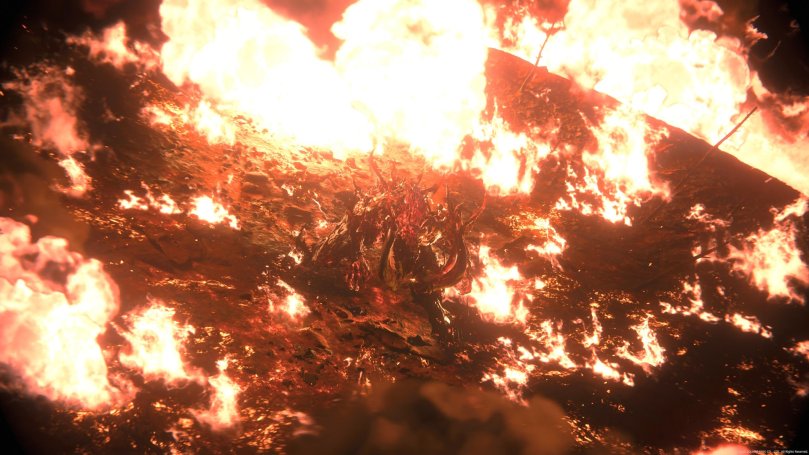
In many of these confrontations, the number of effects covering the screen obscured the view of the action, making it difficult to discern what was really happening. I was almost always spamming buttons, hoping it would be over soon. Eikon battles were designed to be watched, not played. That is what I got out of them.
Story and Characters
I was also watching an enormous amount of cutscenes of high and low quality. Final Fantasy XVI wanted to tell a story, and to do that, it contained hours upon hours of “video” and dialogue. I did not mind (except for the technical shortcoming), as the narrative was compelling.
The most common comparison real reviewers have made is to Game of Thrones, which is very accurate. This sets the tone nicely to summarize how the story feels. It was very mature and full of political machinations. Unlike what I remember from the Game of Thrones books, though, Final Fantasy XVI strayed a lot further into high fantasy the further the game went on. Keeping track of the events and the political landscape was challenging, primarily since all participants were addressed and known by several names. It was good that the game designers included a lore feature I could access while a cutscene played out. The cutscene paused, and I was able to read up on the people or places featured at that moment in the scene. Brilliant.
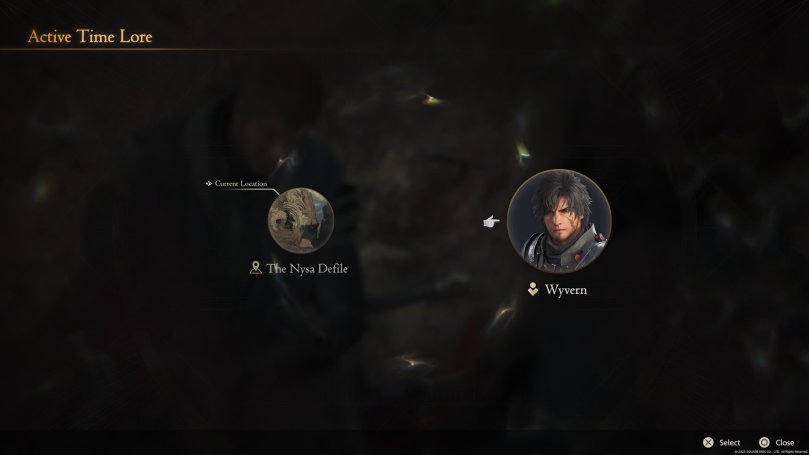
I could even visit a person in the hideout and retrace all the events that had taken place until this point. If you find yourself away from the game for a while, this is a fantastic way to catch up.
All the political grandstanding and territorial warfare that earns Final Fantasy XVI the comparison to Game of Thrones is just a vehicle for the fundamental elements of the story. The game was centered around the notion of equality, fighting for freedom, and people. Citizens with magical abilities, so-called Bearers, suffered discrimination, oppression, and exploitation. Clive’s journey saw him ending this. His worldview was, in many instances, very idealistic, but it was an incredibly commendable attitude to have and to pursue it. In doing so, he met many new people and formed new connections and friendships as the story progressed. He also had a special bond with his “childhood sweetheart” and brother, who played an important role on his journey.
And the dog Torgal.
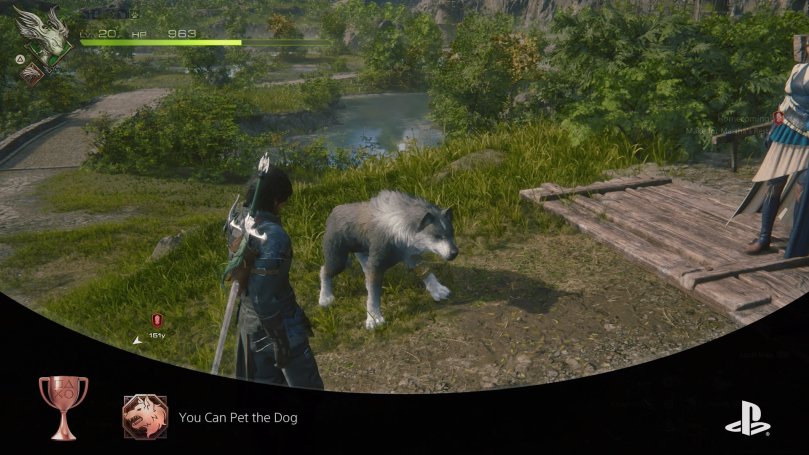
And this is where Final Fantasy XVI shined: building and fostering relationships, making characters relatable and likable, and helping people. All that side content initially appeared dull, but it turned into exciting and heartfelt stories as the game continued. Side missions weren’t just about accepting a request, fulfilling it by fighting some monsters and retrieving an item, returning it, and being done. There was a story behind everything to give it actual meaning. Plus, only by doing side missions did Clive receive some upgrades, for example, more potions in his pouch.
The technical delivery of this content may have needed to be better, but the meat behind it kept me going. Characters mattered, and this made interactions exciting. Sure, many of the cutscenes conversations are deliberate and maybe even drawn out. However, it is undeniable that this game had some fantastic character moments, and because of this, the ending was incredibly emotional.
Famous Last Words
Final Fantasy XVI was one of the biggest and most anticipated games in 2023, and for a good reason. The hype was not lost on me either, as the preview coverage looked very intriguing. I basically purchased a copy on day one (or maybe day two).
But as much as there is to like, the game also has a few flaws, the biggest being the wooden-figure-esque side quest cutscenes. As much as I liked the stories that were told, this technical weak point occasionally sucked out the enthusiasm that I had. I played every side mission I could find in Horizon Forbidden West because of the incredibly engaging interactions between the characters. If Final Fantasy XVI were just half as good… But to be fair, I also immensely enjoyed Horizon Zero Dawn, which has a similar issue.
Final Fantasy XVI was all about its story and accessible spectacular combat. The game did not spam me with endless fluff and complicated mechanics. As such, some elements that did exist were underbaked. Exploration was essentially pointless. Crafting existed in a manner that I did not sweat crafting materials in the slightest. I had no clue what all that stuff actually was. If a new component did more damage or had better protection, I crafted it when the game let me. Armor did not change Clive’s appearance, nor did the hundreds of badges Clive received throughout the game that signaled trust to a particular group of people. I’m sure he wore it on the back of his vest like a true Metalhead.
The upside of this streamlined experience was a focus on moving the main and side story content forward, which I appreciated greatly. I played the game for its story, and I was not disappointed. At all. If you are that type of gamer and play a game by just playing it instead of looking at how it ticks, you’ll likely have a great time.
Thank you for reading.
 The Codeslinger

[…] will try to keep it short this time, unlike in my Final Fantasy XVI or Marvel’s Midnight Suns reviews. I have linked to the Digital Foundry video in the intro, but […]
LikeLike
[…] my review if you oppose […]
LikeLike