Convert Java POJO With Protobuf field to JSON Using Jackson

In this blog post, I will explain how to convert a regular Java class that contains a Protobuf message field to JSON using the Jackson library, for example, in a Spring Boot application as a return value of an @Controller method.

You might wonder, how this is such a big deal? After all, you can create complex POJO hierarchies, and Jackson will pick them up just fine. Well, maybe this error message will convince you.

o.a.c.c.C.[.[.[/].[dispatcherServlet]    : Servlet.service() for servlet [dispatcherServlet] in context with path [] threw exception [
    Request processing failed; nested exception is org.springframework.http.converter.HttpMessageConversionException: 
    Type definition error: [simple type, class com.google.protobuf.UnknownFieldSet]; 
    nested exception is com.fasterxml.jackson.databind.exc.InvalidDefinitionException: Direct self-reference leading to cycle 
    (through reference chain: com.thecodeslinger.ppjs.web.dto.AwesomeDto["awesomePowerUp"]
        ->com.thecodeslinger.ppjs.proto.AwesomePowerUpOuterClass$AwesomePowerUp["unknownFields"]
        ->com.google.protobuf.UnknownFieldSet["defaultInstanceForType"])] with root cause

Java classes that you create with the Protobuf compiler require their JSON converter JsonFormat.Printer. So, how can we get Jackson and JsonFormat.Printer love each other and have a wedding together?

Simple: we create a custom JsonSerializer.

public class ProtobufSerializer extends JsonSerializer {

    private final JsonFormat.Printer protobufJsonPrinter = JsonFormat.printer();

    @Override
    public void serialize(Message anyProtobufMessage, JsonGenerator jsonGenerator, SerializerProvider serializerProvider)
            throws IOException {
        // The magic sauce: use the Protobuf JSON converter to write a raw JSON
        // string of the Protobuf message instance.
        jsonGenerator.writeRawValue(protobufJsonPrinter.print(anyProtobufMessage));
    }
}

This class is very simple and can work with any Protobuf Message class instance. This way, it is universal and only needs to be written once. The main ingredient is the jsonGenerator.writeRawValue method that takes the input without modification. Since we already ensure a proper JSON format using Protobuf’s converter, this is no problem in this case. Otherwise, be careful with this method.

The last step is to annotate the Message field in the POJO, so Jackson knows what to do.

@JsonSerialize(using = ProtobufSerializer.class)
private final AwesomePowerUpOuterClass.AwesomePowerUp awesomePowerUp;

You can find a complete working example that uses Spring Boot and a REST endpoint on my Github account.

Spring Multipart File – Can I Read InputStream Multiple Times?

The short answer is Yes.

Here is the long version and why I even asked myself this question.

If you are familiar with ServletRequest then you probably know that calling its getInputStream method only works once. If you need to read the body data multiple times then it is up to you to cache it in a buffer or employ workarounds such as a "caching servlet request". Unfortunately, this fact is not stated in the Javadoc of ServletRequest#getInputStream so it is no wonder this question gets asked.

Spring’s MultipartFile is a bit different here. It, too, has a getInputStream method, but this one can be called multiple times. Again, it is not obvious from the documentation which is why I am making this mental note for myself and others who are researching this question because they know about the behavior of ServletRequest and assume – as I did – it is the same for MultipartFile. Fortunately, it is not.

In my case I needed to compute a hash of an uploaded file and then move the file to Azure’s Blob Storage. The Azure API used an InputStream and I assumed, once I had consumed the multipart InputStream that I could not use that API anymore.

As a side note: Using DigestInputStream it is possible to do this in one go, move the data to storage and while doing that compute the hash. In my case, I needed the hash first to compare it with a value that was provided on upload. Only when they match can the data be transferred to storage.

Automate Game Screenshot Capture: Windows API SendInput Function with C++

I am trying to write video game reviews after I have finished a game and I like to add some impressions in the form of screenshots to the reviews. There is one problem though: sometimes it is impossible to press the keyboard shortcut to capture a screenshot because the game requires my full attention – and all my fingers. Therefore, I miss out on a lot of action sequences. What does a programmer do in such a situation? Write a tool that scratches the itch.

Read More »

Comparing Java Optional vs C++ STL optional

Optionals in Java have been around for some time now, basically since the release of version 8. My other language of choice, C++, has received this feature in version C++17. Since I am currently in the process of writing some C++ code, I was curious how they were implemented there. Optionals are trying to solve a problem that is likely to plague any language. What shall a method or function return if there is no value? Or shall it not return anything but instead start crying like a petulant child and throw an exception?

As an introduction, let me dive a little bit into why we need optionals (or do we?) and compare two different implementations of this concept, one being java.util.Optional and the other C++ std::optional. I chose to compare these two language for several reasons:

  1. I work with Java in my day job, so I have a good idea of how it works there.
  2. As mentioned, C++ is one of the languages I know quite well too.
  3. The main reason: both optional implementations are add-on classes rather than language features. More on that later.
Read More »

Spring @ConfigurationProperty a Bean or not?

Semi-recently (“semi” because procrastination kept me from writing, so it’s more like two months ago, but blog posts have to start with “recently” when you try to explain yourself why you are writing what you are writing – but I’m getting sidetracked here, so let’s move on) I was wondering whether Java classes annotated with Spring’s @ConfigurationProperty should be declared as a bean, e.g. with @Component. I didn’t find a definitive answer, but I found three ways on how to do it – typical Spring, I guess.

Here’s a quick setup:

My configuration class.

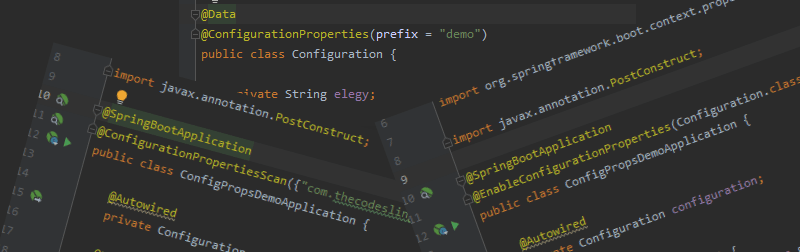
package com.thecodeslinger.configpropsdemo;

import lombok.Data;
import org.springframework.boot.context.properties.ConfigurationProperties; 

@Data 
@ConfigurationProperties(prefix = "demo")
public class Configuration {

    private String elegy;
}

My main application:

package com.thecodeslinger.configpropsdemo;

import org.springframework.beans.factory.annotation.Autowired;
import org.springframework.boot.SpringApplication;
import org.springframework.boot.autoconfigure.SpringBootApplication;

import javax.annotation.PostConstruct;

@SpringBootApplication
public class ConfigPropsDemoApplication {

   @Autowired
   private Configuration configuration;

   @PostConstruct
   public void postConstruct() {
      System.out.println(configuration.getElegy());
   }

   public static void main(String[] args) {
      SpringApplication.run(ConfigPropsDemoApplication.class, args);
   }
}

And finally, my properties file:

demo.elegy=R.I.P. Kobe

It’s not an elegant setup, but that’s not the point. It does the job for now.

If you run the application in this state, Spring will greet you with an error message.

APPLICATION FAILED TO START

Description:
Field configuration in com.thecodeslinger.configpropsdemo.ConfigPropsDemoApplication required a bean of type 'com.thecodeslinger.configpropsdemo.Configuration' that could not be found.
The injection point has the following annotations:
- @org.springframework.beans.factory.annotation.Autowired(required=true)
Action:
Consider defining a bean of type 'com.thecodeslinger.configpropsdemo.Configuration' in your configuration.

It obviously cannot find the configuration bean.

Option #1: Slap @Component to it.

package com.thecodeslinger.configpropsdemo;

import lombok.Data;
import org.springframework.boot.context.properties.ConfigurationProperties;
import org.springframework.stereotype.Component;

@Data
@Component
@ConfigurationProperties(prefix = "demo")
public class Configuration {

    private String elegy;
}

Option #2: Use the @EnableConfigurationProperties annotation.

import org.springframework.boot.context.properties.EnableConfigurationProperties;

@SpringBootApplication
@EnableConfigurationProperties(Configuration.class)
public class ConfigPropsDemoApplication {

Option #3: Use @ConfigurationPropertiesScan to explicitly name the packages to scan for.

import org.springframework.boot.context.properties.ConfigurationPropertiesScan;

@SpringBootApplication
@ConfigurationPropertiesScan({"com.thecodeslinger.configpropsdemo"})
public class ConfigPropsDemoApplication {

All three options achieve what you’re aiming for, a running application.

:: Spring Boot :: (v2.2.4.RELEASE)
2020-02-03 19:57:43.562 INFO 4612 --- [ main] c.t.c.ConfigPropsDemoApplication : Starting ConfigPropsDemoApplication on DESKTOP-C0O3OKC with PID 4612 (D:\OneDrive\Code\Java\config-props-demo\target\classes started by lober in D:\OneDrive\Code\Java\config-props-demo)
2020-02-03 19:57:43.562 INFO 4612 --- [ main] c.t.c.ConfigPropsDemoApplication : No active profile set, falling back to default profiles: default
R.I.P. Kobe
2020-02-03 19:57:43.921 INFO 4612 --- [ main] c.t.c.ConfigPropsDemoApplication : Started ConfigPropsDemoApplication in 0.573 seconds (JVM running for 1.083)

So, is there any benefit of one over the other? The Spring documentation has the following to say:

Sometimes, classes annotated with @ConfigurationProperties might not be suitable for scanning, for example, if you’re developing your own auto-configuration or you want to enable them conditionally. In these cases, specify the list of types to process using the @EnableConfigurationProperties annotation. This can be done on any @Configuration class, as shown in the following example:

I’m not using a @Configuration class in my example, but if you were, you could leverage that to load your configuration classes based on @Profile annotations. Although @Component works too, it’s not mentioned in that part of the Spring documentation (“Type-safe Configuration Properties”).

For myself, I might go with @EnableConfigurationProperties and if it makes sense, even have dedicated @Configuration classes linked to @Profile. For little samples like this one it’s obviously overkill. In a remotely useful application, the additional overhead may be worth it for structural and documentational reasons.

Kotlin Object Expression – What more can object do?

In a previous post I explained what Kotlin Object Declarations are. This time around it’s about the declaration’s sibling, the Object Expression.

An object is not just a glorified static replacement or a singleton. object can be used where Java usually utilizes anonymous inner classes. Let’s look at a more realistic scenario: a JButton and an ActionListener or a MouseListener.

Read More »

Kotlin Object Declarations – The fake-static

Instead of implementing my own backup application as I had planned a long time ago, I’m wandering off (re)learning Kotlin after a long absence from that language. In my defense though, I’m doing it in the context of the backup app which will not be Java as originally intended (or maybe later for comparison, who knows, I obviously can’t be trusted with my plans). Putting that aside, the most confusing concept of Kotlin for a Java developer is the object. What is that thing doing that a class can’t do and how do we declare static fields and methods? I know it’s nothing new, but that part seems to have changed a bit since I used Kotlin about two (?) years ago. So, for me this is a refresh of old information and also something new and by writing about it I will engrave it in my brain once and for all. And your confusion will hopefully turn into some productive… fusion… of some sort… or so.

Read More »

Micrometer and Spring (Non-Boot)

Almost all of the tutorials and blog posts I found on this topic were focused on Spring Boot because, starting with version 2, it uses Micrometer as its metrics framework. However, in a particular project at work we do not have access to Spring Boot let alone a recent Spring version. Therefore, I’m explaining how to include Micrometer in your non-Boot Spring application using XML configuration.

In this tutorial I will be using Spring 5 and Java 11, so not exactly the versions I’m dealing with at work, but the concepts are the same and everything can probably be copied exactly as shown here.

Read More »

A Java “DSL“ for Simple Unit Test Data Creation

I’m a person that usually writes tests before the implementation. In the context of my backup application project this has turned out to really slow me down. But it’s not just a problem of my personal projects. It also affects my professional work. 

Here’s the issue: for some tests you need test data and generating that test data can be a tedious task, depending on the complexity. This has caused me to procrastinate on my backup app. So, one evening, after having thought about this during a workout, I grabbed my laptop, sat down in my comfy bed and wrote a “DSL” that makes creating the data much simpler. Not only is it easier to create the data now, allowing me to continue at a faster pace, it’s also much more readable and the test setup doesn’t clutter the test case anymore. This is a very important aspect of a test. What good does it to have one if, after some time, you have to update it and don’t understand what it does anymore?

Read More »

Using TagLib with pytaglib in Python

I tend to write a lot of background to paint a picture why I’m doing things, so I’ll try to keep it short for to move on to the code quickly.

I have a digital music collection that was sorted by the first letter of the artist (A, B, C etc.) and then the artist and underneath that the albums. While that is good to find things, it’s not optimal for listening in my car (via USB stick). Sometimes I find myself wanting to listen to all of Melodic Death Metal on shuffle play. My car doesn’t support this like iTunes, with its internal music library, which is why I wanted to group artists and albums by genre. Since I didn’t plan to do this all manually, I opted to write some scripts in Python.

The code is available on GitHub. If you have suggestions for improvements, please comment or create a pull request. I’m not a Python pro, so I’m sure there’s some room to make it better.

Read More »

Jules White Programming Cloud Services YouTube Video Series

In my search for information about what a web.xml exactly is and does, I ran across a video series on YouTube of Dr. Jules White who created over 70 videos explaining the basics and advanced topics of creating web services for mobile applications. The videos are roughly between 5 and 15 minutes long, so they are ideal for in-between watching, without sacrificing in content. You can binge them too, of course.

What I found most pleasing is that his presentation style is very informative and professional. There are no awkward pauses or anything else that would make me cringe. It’s very pleasant to watch and there’s a lot of good information in it, even for someone that already has a background in building web applications.

I created this list of links to all the individual videos because wanted to have more structure and information than a YouTube Playlist can provide in case I want to go back and watch something particular. Additionally, there’s a little sorting and numbering bug in the YouTube Playlist 😉

So, here you (or I) go.

Read More »

enable_shared_from_this: boost vs. std

If you are a modern C++ developer, then you are probably using some kind of smart pointer implementation. The boost C++ libraries offer one possible solution (among many other useful features) and are generally held in high regards in the C++ community. With the latest C++11 standard, some of those ideas found their way into the standard library bundled with your C++ compiler. At some point, you very likely run into a situation where you need a shared_ptr of one of your classes, but only have a raw pointer or this available.

This is where enable_shared_from_this comes in. Boost and the standard C++ library provide this feature and they both have a very important prerequisite for this to work.
Read More »

The Pitfall of Trying to Be Too Smart When Using dllexport/dllimport

As a seasoned C++ developer I should’ve been aware of this which makes it a little bit embarrassing. But, since this issue has cost me several hours of searching through the Internet over the course of two or three days, I thought it might be worth sharing. Maybe somebody else is trying to be too smart or just doesn’t know better.

The problem? It is summarized in short in this StackOverflow question that I posted. With this blog post I’ll be a bit more elaborate and show some details.
Read More »