Marvel Rivals Benchmarks: AI Super Villain or Open Source Hero | Windows vs. Linux | RX 9070 XT

Marvel Rivals is published by NetEase, the same company that also publishes Where Winds Meet. Unlike its sibling, Marvel Rivals uses Unreal Engine 5. And as we all know, this piece of software can be as volatile as Deadpool. So, let’s have a look at how the hero-shooter performs on Linux and Windows.

Welcome back to a new benchmark battle between these two operating systems. Today, we answer the question of whether the proprietary AI-Super Villain or the Open-Source hero comes out victorious.

As I’ve done more often recently, I compared the beloved 🤭 Windows 11 to Bazzite’s Steam Gaming Mode and its KDE-Wayland session. Let’s go and find out which operating system has a field day in Marvel Rivals.

To do that, we grab Thor’s Hammer – don’t worry, no sleezy jokes today – and hope we can prevent Windows from sprinting ahead with a few well-placed lightning strikes.

I actually have no idea if Thor’s even in this game, but let’s just ignore that.

I also have a German version of this video.

Read More »
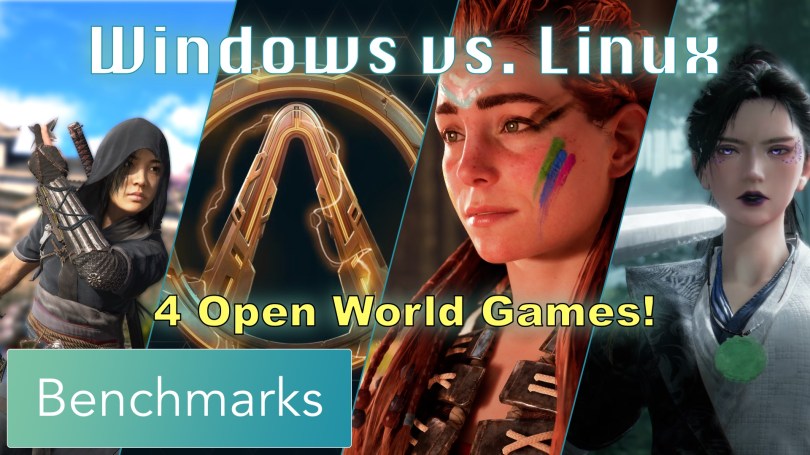
4 Open-World Titles In Linux vs Windows Benchmark Battle (ACShadows, BLands4, HFW, WWM) | RX 9070 XT

I had a few games in my sweaty grasp this year that ran rather meh on Linux. In the last game I analyzed, I found out that the Mangohud performance overlay can negatively impact a game’s performance. Hogwarts Legacy stuttered heavily in my first test when I explored the world. This is a behavior that you wouldn’t encounter when just playing the game. I only ran into this issue because I always show the Mangohud performance metrics for my analysis videos.

That sparked a desire to retest a few games. I was already planning to benchmark Borderlands 4 a second time since Gearbox supposedly tuned the transmission for better performance. It so turned out that Borderlands 4 was joined by the robo-dinosaur-tamer Aloy, the two mass murderers Naoe and Yasuke, and the dude who fights with a baby in his arms.

And with that, I welcome you to another Linux versus Windows benchmark battle. This time, with four games instead of just one.

I don’t want to waste any more time beating around the FPS, so let’s get right to it.

I also have a German version of this video.

Read More »

Pragmata: The RE Engine Delivers! | RX 9070 XT Linux Performance & Impressions (Bazzite 43)

(World Premiere)

Alright, alright. I admit, I’m exaggerating here. It is true for me, however. The unique thing about Pragmata is its use of the RE-Engine, which is like venturing into new territory for me. I have avoided the Resident Evil games and, by extension, the RE Engine because I’m officially in the scaredy-cat camp when it comes to horror games. As a result, Pragmata shines among the many Unreal-based stars in outer space.

And with that, hello and welcome to a Linux Gameplay Performance blog post.

The Pragmata demo was announced at The Game Awards 2025, and the game is slated for release in April 2026.

Will Pragmata’s launch into the Linux universe be soft, or will the trek to orbit be a rocky one?

Here’s a German version of the video.

Read More »

Total War: Three Kingdoms Benchmark-Battle Linux & Windows | RX 9070 XT (Bazzite 43)

If you regularly watch Gamers Nexus benchmark videos or are just a strategy game enthusiast, Total War may be a name you recognize. It has been quiet as far as “Mystery Games” go in the Epic Games Store, but at the end of the year, Tim Sweeney handed out a household name in the strategy space for free. I took this opportunity by the hand to check out Total War for myself and, of course, also benchmark it.

And with that, I welcome you back to another Linux versus Windows benchmark battle.

I usually prefer to do a Gameplay Performance first, before diving into the benchmarks. However, I’m sad to say that Total War: Three Kingdoms just isn’t my cup of tea. Therefore, I spent only as much time in the game as I needed to record some B-roll and get the testing done.

But enough foreplay. Let’s get to the climax and the question of who’s packing more heat.

Yes, you heard that right. And there’s plenty more where that came from.

(German version of the video)

Read More »

South of Midnight Benchmarks & Critique (Linux vs. Windows)

Compulsion Games and striking art might as well be synonyms in dictionaries. South of Midnight’s visual identity is unmistakable, but it does not stop there. The game is more than just artsy graphics.

But before I briefly share my opinion on the game, let me talk about the technical side of things, which is central to this blog post. The primary focus is how South of Midnight performs on Linux and Windows, how difficult it was to get working, and things I noticed while playing on both platforms.

The Nerdy Bits

I purchased the game on Steam, and as one has come to expect, it just worked. I did not force any Proton version and let Steam do its thing instead. Throughout my playtime, I did not have any issues whatsoever. South of Midnight felt like it belonged.

Read More »

Star Wars Outlaws Benchmarks & Critique (Linux vs. Windows)

Star Wars Outlaws is Ubisoft’s take on a Star Wars game working within the framework of their established Open-World formula. Although Massive Entertainment worked to avoid the checklist-like map design full of question marks, it still ended up being a checklist, just not on the map. And underneath all that busywork is a heist story along the lines of Ocean’s 11. With a twist.

But before I briefly share my opinions on the game itself, let me talk about the technical side of things, which is at the center of this blog post. The main focus is how Star Wars Outlaws performs on Linux and Windows, how difficult it was to get working, and things I noticed while playing on both platforms.

The Nerdy Bits

Let me start with the installation. I purchased the game on Ubisoft’s platform instead of Steam, so I had to resort to Lutris for the first step. After I installed the Ubisoft Connect launcher via this handy script, the procedure was the same as on Windows: select the game to install, the install location, and start the download.

In Lutris’ settings, I chose Proton-GE as the runtime, but I also tried Wine and Proton Experimental. Since I noticed no differences, I stuck with what I tested last, which was Proton-GE.

Benchmarking Preamble

I tested on my AMD Ryzen 7600 with 32 GB of DDR5 6000 Mt/s memory and an AMD Radeon RX 7900 XT. Windows 11 was on version 24H2 as of the end of March. My Linux installation was a regular Fedora 41 Workstation with Gnome Shell on Wayland running kernel version 6.13.8. Since I play at 1440p, that was the only resolution I tested. For graphics settings, I limited myself to Ultra and High, each at native resolution and upscaling with FSR Ultra Quality.

I ran every benchmark pass three times in one go instead of performing three separate runs and averaging the numbers. I am lazy, and I also assume that the result would be the same.

Read More »

Kena Bridge of Spirits Review (PC)

I do not recall when I first became aware of Kena Bridge of Spirits. According to this announcement trailer, it must have been sometime in 2020. I was immediately hooked, but I did not jump in right away when it launched in 2021. I do not even remember why. It was a tough year for me personally, so maybe that was one of the reasons. Whatever it was, I am rarely on time with game releases, so why would Kena Bridge of Spirits be any different?

It is a different game, though (horrible segue *cough*), and one that I think stands out among all the others I have played in the past decade. Kena Bridge of Spirits is a PlayStation and PC exclusive, and it is the first title I played after building a gaming PC after just one year of abstinence. I haven’t heard much of this game after its release. Still, it apparently did well enough for Ember Lab to warrant a free anniversary upgrade at the end of September 2022.

Close combat games aren’t usually my jam. That is not because I do not like them. It has more to do with my inability to master the combat for an enjoyable experience. I must often resort to the Easy difficulty to complete challenging sections or bosses, and in the majority of times, the Easy mode is so accessible that it is borderline boring. Despite that, I went into the game with an open mind, and I am glad I did. I still had trouble with some of the bosses, but for the most part, I fought my way through the game on the normal difficulty. Let me tell you about it.

As always, I begin by discussing the game’s technology.

Read More »

Linux Gaming: Middle Earth – Shadow of Mordor; Get it to run, and run it fast

Gaming on Linux is a challenge because only a few companies take the time to create native Linux ports of their games. It is even more challenging when those natively ported games do not run at all or do not run well. One of them is Middle Earth: Shadow of Mordor. I have bought this game specifically because it has a native Linux version – and because I remember that it was well received by media and players.

This game has two issues:

  • It refuses to start in full-screen mode.
  • The performance is terrible.

Let’s go through these two issues and see how they manifest and how to fix them.

Read More »