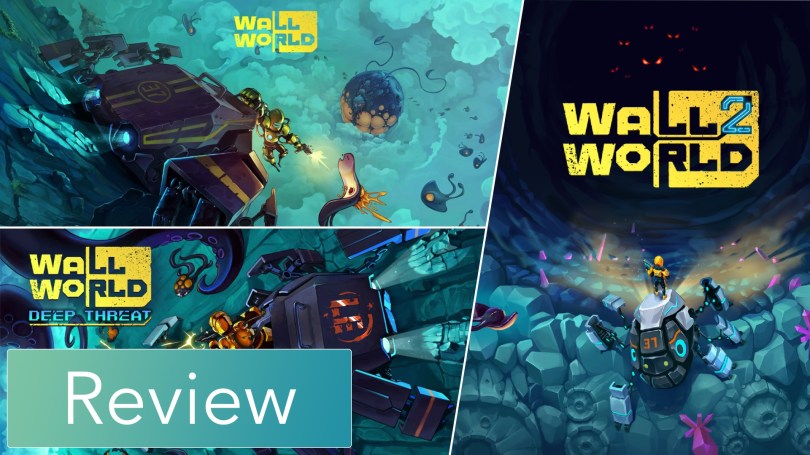
Most gamers probably know that particular feeling that old games like the original Diablo series evoked in us. We always used to say: “just one more dungeon” or “just one more quest”.
It’s this feeling wanting to continue a game no matter how long you already spent in front of the tube or how low the sun is on the horizon. It’s this feeling of slicing through hordes of enemies with a friend, hunting for the next level-up, finishing a quest, or just enjoying the gameplay because it’s hell-a-fun.
It’s this feeling… that barely any game could elicit in me recently.
I’m not saying I didn’t have no fun in any game. That’s not the case, and it wouldn’t be fair to any of the titles I’ve finished. However, only a tiny number was so captivating that I couldn’t stop playing or wait to get back to the living cable box.
After all this prologue, you can probably guess where this is going. And you’re correct. But before I get to that, I need to tell you how I ended up playing Wall World in the first place.
😅
The answer is YouTube, of course. One of the two gaming creators I follow started playing around the day of Wall World 2’s release. I saw it as nice white-noise programming while I was doing other things. But the more I took in through osmosis, the louder “this feeling” came back, knocking. As a consequence, I picked up Wall World 1 and 2 during the Steam Christmas sale and also added the Deep Threat DLC after beating the first title.
I also have a German version of this video.
Wall World & Deep Threat DLC
As a responsible gamer, I of course started with the first entry in the series, and it immediately clicked. The feeling I mentioned earlier took over so strongly after a while that, one evening, I spontaneously decided to record a short “Let’s Play On Linux” series on my German channel. And shortly after, I beat it and eternalized its ending on the virtual silver screen.
Wall World threw me into its world without any explanation of the goal. I felt like a newborn child in our world. The more this title opened itself up to me, the more I developed a sense of wonder. Finding the first Crypto Key, in particular, raised some questions because it didn’t serve an immediate purpose. This contrasted with all the other upgrades I had found up to that point. Normally, you invest resources in upgrades for your Robo-Spider or your Wall-Digger to enhance its weapon systems to defend against the waves of Zyrex enemies or to optimize the drilling capabilities.
The gameplay loop that emerged struck a perfect balance between efficiently mining resources and exploring mines for upgrades and the remaining Crypto Keys. Some upgrades are limited to a single run, and some span across runs once purchased back at the base for resources. It was the first time I had fun playing a rogue-lite, despite the story not being at the forefront of the experience. For example, Hades could not hold my attention because I failed every skill check in this game. I never felt like I progressed, no matter how long I played.
It’s this aspect that fully enthralled me about Wall World. At some point, my Robo-Spider was fast and resilient enough that I held my ground against the first boss. My spirit of discovery was the fuel for my Robo-Spider. I suddenly found myself in new regions, found new upgrades for my ride, and harvesting resources became more efficient. It became a virtuous circle that continuously fed my lizard brain with dopamine. Even if my Wall Digger had to pull the emergency escape lever during a boss battle, it meant that I could then purchase upgrades or unlock other goodies to make the next run a little bit better.
After a while, I also found the purpose of these Crypto Keys. And over time, I developed the best strategy to survive long enough to find all of them and amass enough firepower to transport the keys to their intended destination.
The DLC had more of that and also a few more interesting lore pieces that I won’t spoil. However, if you’re curious and understand German, I have two short playlists on my German channel: one for the base game and one for its Deep Threat DLC, each with around three to four videos.
And that’s how I experienced the special feeling I mentioned at the beginning. “Only one more dungeon” turned into “Only one more run”.
Wall World 2
I think this would have made a fitting end to the review, but I’d like to continue with Wall World 2 right away. After all, this was the reason for my wall exploration shenanigans. I can also kill two Zyrex with only one cluster bomb this way.
The intro to part two couldn’t be more different and immediately hinted that storytelling would play a more prominent role. Developer Alawar cannot and doesn’t want to compete with superpowers like Naughty Dog, but it’s a dramatic departure from the first game. There’s more dialogue pushing the content forward, and the game has sequences that I’d cautiously describe as cutscenes or set-piece moments.
The devs decided to continue where the first Wall World ended and open up the world by dividing it into different regions. Every region has a set of missions that earn research points to fill a progress bar. Once it is full, a special mission becomes available to continue the story. The gameplay feels familiar at first while you still upgrade the basics of your gear. Eventually, this starts to feel like busy work because the whole concept has changed. Additional story moments and character interactions came at the expense of the original game flow. It hurts to say, but what once was a rogue-lite became a regular, mission-based game with a simplistic fetch-quest design.
Instead of being forced into a battle with the Leviathan, you can extract from the mission area after completing a quest objective, avoiding all remaining Zyrex waves and the boss. This design decision removes the original game’s sense of threat. What was required in the first game is now optional – unless you want to, of course. Also, meaningful progression through upgrades nearly ground to a halt after about half of the game. Since the missions required me to focus on the goal, the sense of exploration that led me to search the mines for weapons or blueprints was left behind. I can count the runs in which I used a weapon other than the default machine gun to fend off Zyrex waves on one hand. The diversity of weaponry became secondary because it was no longer required.
Of course, this meant the game is much more accessible to a wider group of people. It simply requires less time commitment per individual run. The flip side of the coin is losing what made Wall World so charming in the first place. I found this especially noticeable since Wall World 2’s runtime is over twenty hours. The gameplay simply lacks variety to fill those twenty hours and keep them engaging from start to finish.
And it’s a shame, really. I think part two is a welcome continuation, with its stronger focus on story and lore to discover. The devs also included a combat system in the mines, which turns the game into a bullet hell shooter from time to time. When you’re on a mission, this adds an extra layer of tension.
So, on the one hand, Wall World 2 is an evolution of its predecessor, but on the other hand, it’s a departure from what made it special. I only really noticed that the further I progressed and the game design pattern repeated itself for the third time. It feels like the meta-progression was lost between the two titles, and “this feeling” could not be carried over from the first entry in the series.
Famous Last Words
I’d like to emphasize that I still enjoyed Wall World 2. Sure, the repetition that stretched out this game incentivized me to take the route of least resistance toward the end. Meaning: I skipped missions that weren’t necessary for progression. I wanted to leave this game with a good feeling, which I did.
You also have to consider pricing in this discussion. Both games are very affordable, and what you get in play time is hard to beat. The music fits perfectly, the pixel art is charming, and the core gameplay has this rare combination of relaxation and thrill. On top of that, the game tries to depict the Wall and its history in mysterious ways, which it does a good job of in my opinion.
This little experience certainly changed my perspective on games of this type. It broadened my horizon.
I think it’s also needless to say that this game runs perfectly on Linux. Although… now I did, in fact, say it. Part 2 also runs on macOS, and my MacBook Pro had no issues running at high frame rates.
As we’re coming to an end, I spin up my drill one last time to destroy the blocks that separate us from the outro.
Thanks for spending your time with me today. Have a good morning, afternoon, or evening wherever you are on the globe.
 The Codeslinger