I had a few games in my sweaty grasp this year that ran rather meh on Linux. In the last game I analyzed, I found out that the Mangohud performance overlay can negatively impact a game’s performance. Hogwarts Legacy stuttered heavily in my first test when I explored the world. This is a behavior that you wouldn’t encounter when just playing the game. I only ran into this issue because I always show the Mangohud performance metrics for my analysis videos.
That sparked a desire to retest a few games. I was already planning to benchmark Borderlands 4 a second time since Gearbox supposedly tuned the transmission for better performance. It so turned out that Borderlands 4 was joined by the robo-dinosaur-tamer Aloy, the two mass murderers Naoe and Yasuke, and the dude who fights with a baby in his arms.
And with that, I welcome you to another Linux versus Windows benchmark battle. This time, with four games instead of just one.
I don’t want to waste any more time beating around the FPS, so let’s get right to it.
I also have a German version of this video.
Benchmarking Preamble
Let me briefly introduce the hardware and software I tested with before we get to the bar graphs. You can see the hardware on screen. In terms of software, Windows 11 and Bazzite 43 were up to date as of Christmas 2025.
Core Isolation and Memory Integrity Protection are disabled in Windows 11.
I tested two modes in Bazzite: the traditional desktop using KDE on Wayland and Valve’s Gamescope fullscreen experience, which Bazzite calls “Steam Gaming Mode”. I own all games on Steam and didn’t do any manual tuning or select alternate Proton versions. It’s essentially the out-of-the-box experience you get when purchasing and running a game.
Let’s start with an Open-World title.
Alternate Robert: Open World? You tryin’ to be funny? Ate too many clowns for breakfast? These are all Open-World. Old gamers and their stupid jokes.
Benchmarks
Assassin’s Creed Shadows
The mass murderer simulator in feudal Japan didn’t fare too well on Linux in my dedicated benchmark video. It was one of those games that’s a helpless peasant on Linux.
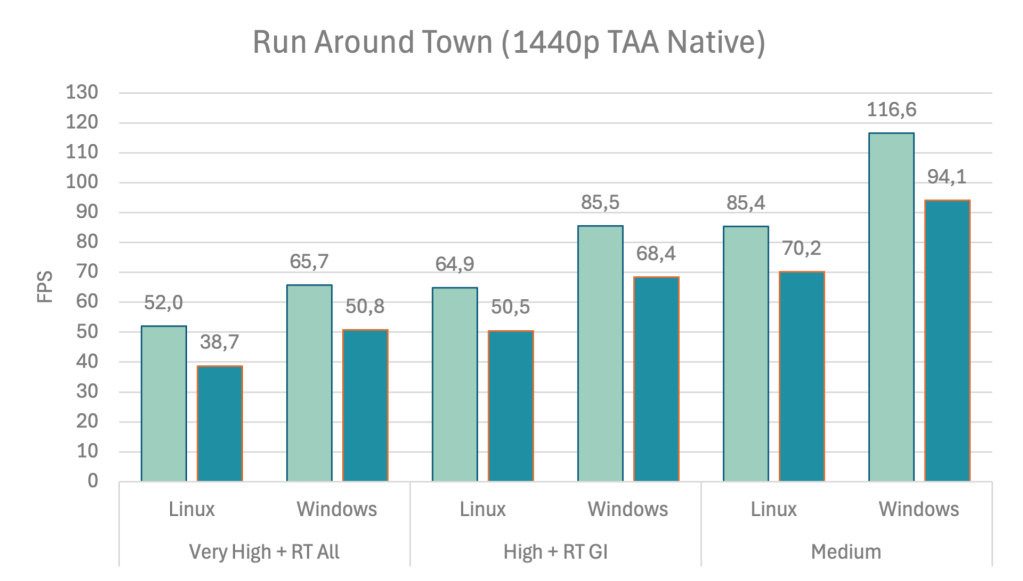
When using the Medium preset without ray tracing, Windows was ahead by 37%. On the Very High preset and all RT effects, we’re still looking at 26%. Windows was the unbeatable final boss of the Yotei-Six.
Yes, I know, wrong game. But that’s easier to say than Shinbaka… Shinfu… Sch… Schin… Yotei-Six in a different game.
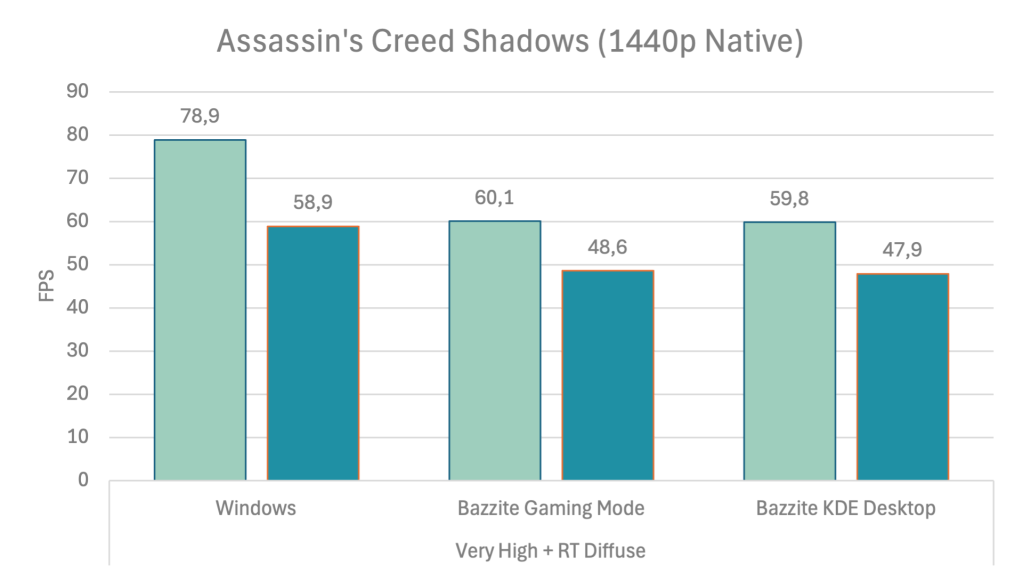
Unfortunately, it doesn’t look any different in today’s benchmarks. Windows still performs in a different league above Linux and remains the best choice for Assassin’s Creed.
We all know that curiosity kills the cat, and I wanted to know which visual compromises I would have to make to get to the same level. Since the desktop and Gamescope results were essentially the same, I only benchmarked the desktop for this.
To achieve Windows-level performance, you must change two things. For one, you need to reduce the quality preset to “High”. Secondly, you need to restrict ray tracing to the hideout. Personally, I wouldn’t make that tradeoff. Quite the opposite, in fact. I would also like to enable RT reflections.
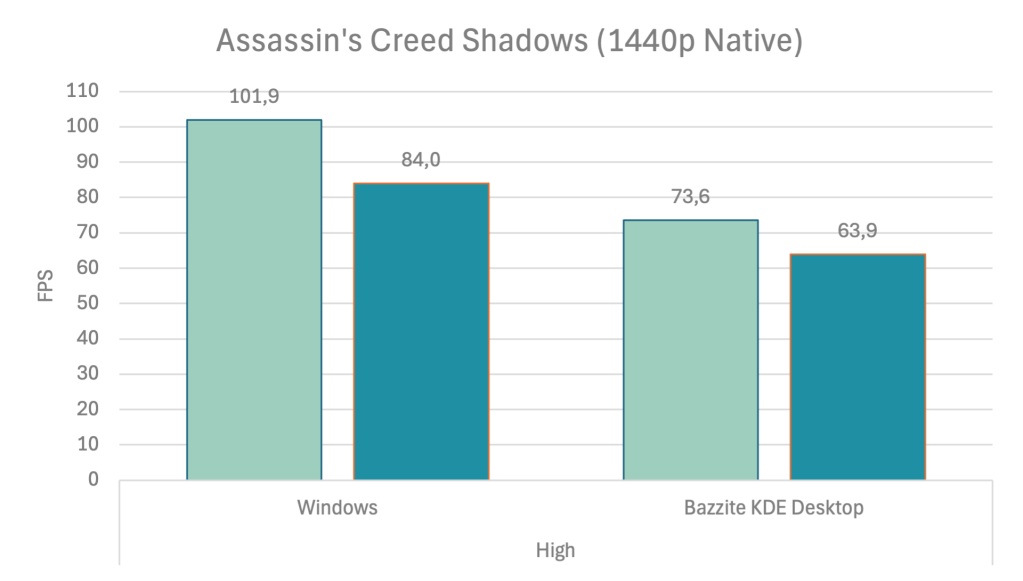
But of course, I was also interested in how Windows handles these settings. And you can see the result. It dominates. Clad in tight leather. With a whip in the left and some sake in the right hand.
After this humiliation, we tumble into the next Open-World game slightly inebriated. One that runs meh everywhere.
Borderlands 4
Randy’s Premium Game for Premium Gamers has performance issues on all platforms.
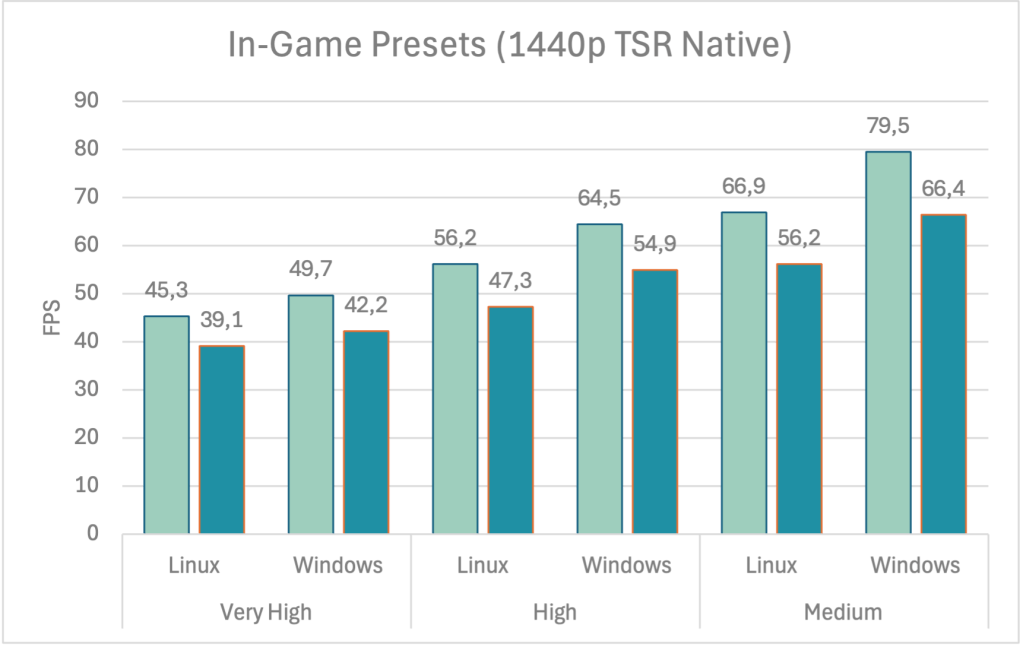
In my first tests, Windows led Linux between 10% on the Very High and 19% on the Medium preset. I’d consider this typical Unreal Engine 5 scaling behavior. But that doesn’t matter a bit since it just ran Bad and Ass.
When we compare the results from launch with today, we can see two things. Gearbox did, in fact, improve the game’s horrendous performance. Maybe drivers also play a role, but we gamers don’t care. Linux and Windows are basically on par now.
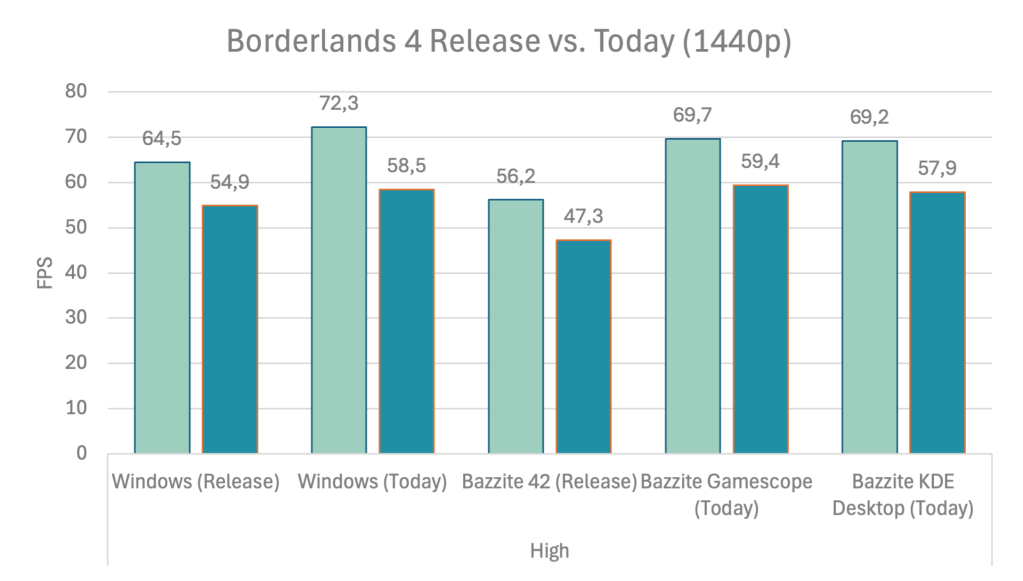
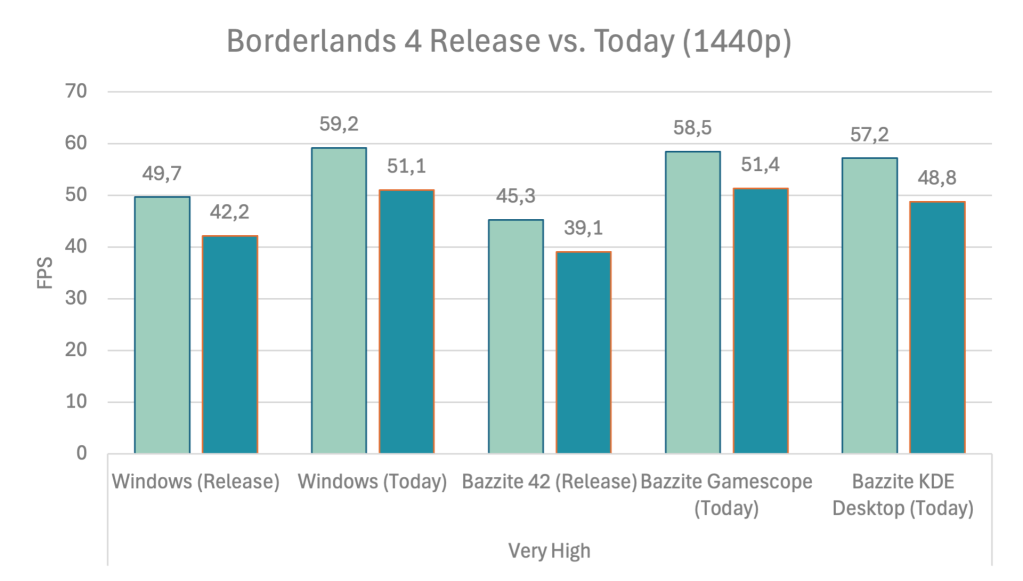
I also examined settings that are closer to what I would consider a smooth experience for a shooter. To avoid reducing visual settings too much, I enabled TSR Quality upscaling. This makes it easier to compare performance at the same quality on all platforms.
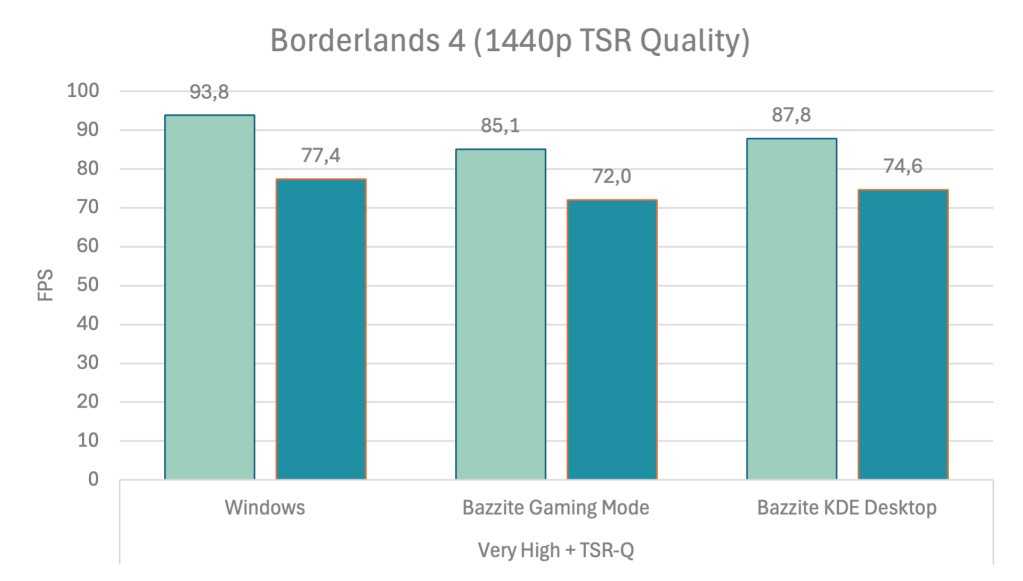
Long story short: With the Very High preset and quality upscaling, Windows barely leads Linux by 10 FPS. That corresponds to roughly 10% on average and falls within the run-to-run variance range in the 1% low department.
I’d say you can play Borderlands 4 on Linux without any regrets.
Let’s move on from this badass benchmark to an Open-World game. That originated on a console.
Horizon Forbidden West
You cannot compare my first benchmarks with today’s results. I was using different hardware at that time. It was a Ryzen 7600 and a Radeon 7900 XT. I included this game because I was interested in current data, and because it uses its own custom engine.
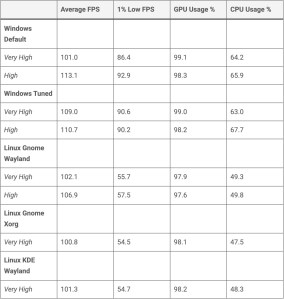
In my initial tests, the results were plagued by constant traversal stuttering. They were resolved only shortly after. However, I cannot say whether that was a Kernel-level, driver, or Proton fix.
In April 2024, I found generally good performance on average, with serious consistency issues. The 1%-low values turned Linux into an Outcast, which made itself known to the player as frequent stutters.
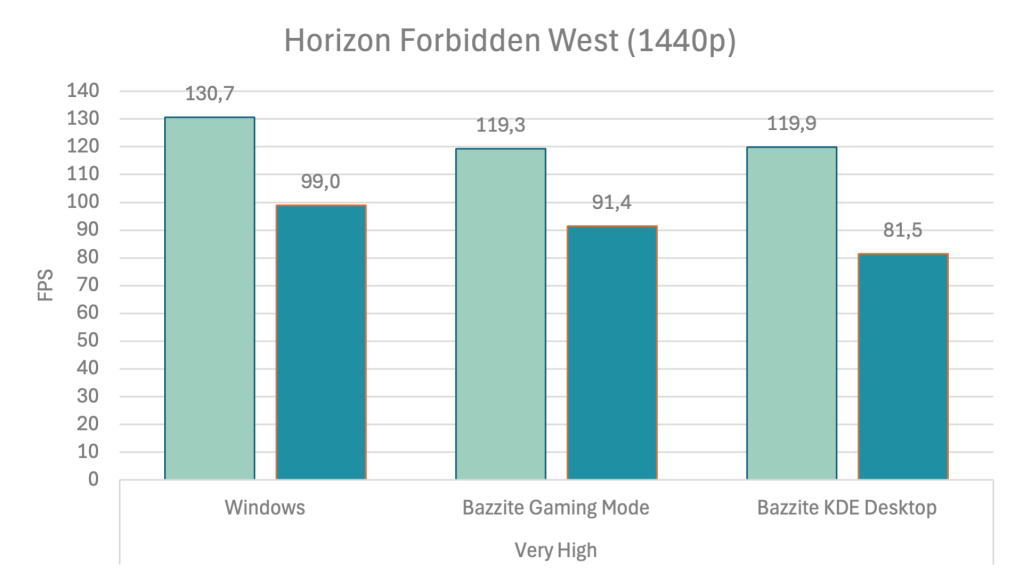
It’s an entirely different story today. Like in other games, Windows pulls ahead by roughly 10%. The general performance is so high, though, that you won’t notice the difference of 10 FPS. Why the desktop results suck in comparison remains a mystery. That’s an average of a couple of runs.
Horizon Forbidden West is one of those rare gems that were heavily optimized for consoles and run great everywhere.
Now we tame a charger and ride toward the final game, an Open-World title. From China.
Where Winds Meet

I only have a gameplay analysis video for Where Winds Meet, no benchmarks yet. What I noticed at the time was generally good performance, which dropped significantly in settlements. Since I’m sensitized to such behavior since the Hogwarts-Mangohud incident, I wanted to check out the Chinese dress-up sword-fighting game in a benchmark.
To be honest, I’m a bit surprised by the results. I have not performed a direct comparison with Windows before this benchmark – only a brief sanity check. But what we see here was consistent across several tests. Windows is the dominant leader. I suppose the leather joke from earlier better fits this title than AC Shadows.
However, other than Ubisoft’s game, Where Winds Meet remains very playable. The performance drops in settlements aren’t as severe as I first thought during my initial performance analysis. And I assume that was Mangohud’s fault. An educated eye can notice the drop from 90 to 60 FPS, but I wouldn’t consider it game-breaking.
That’s it in terms of benchmarks. All that’s left for me to do is a segue without mentioning Open-World.
Famous Last Words
I swear I’m not trying to make Linux look bad by choosing problematic games. If we’re honest, most modern games are based on Unreal Engine 4 or 5 anyway. And such games usually run without issues and perform close to Windows.
But let’s be real for a moment: Gaming on Linux works very well at the end of 2025 and the start of 2026. Most titles just run. If you’re not doing direct comparisons with the old bull, like I am, you probably won’t notice that there’s more potential. Meaning: just play and enjoy the game.
But exceptions tend to prove the rule, and they’ll continue to exist for a while. At least all the games I showed today just run. You can’t say that about many competitive online shooters, which have a plethora of anti-cheat mechanisms.
What I also noticed in many of my tests was how Windows runs away from Linux when the GPU is no longer the bottleneck. This often happens when you enable the Medium or Low presets. I think that’s when you feel the effect of the Proton translation layer taking its toll. But when the GPU is under full load with all effects enabled and a high resolution, the CPU usually has enough cycles left to work around this limitation.
And with that, I mention Open-World for the last time.
Thanks for spending your time with me today. Have a good morning, afternoon, or evening wherever you are on the globe.
 The Codeslinger