
(World Premiere)
Alright, alright. I admit, I’m exaggerating here. It is true for me, however. The unique thing about Pragmata is its use of the RE-Engine, which is like venturing into new territory for me. I have avoided the Resident Evil games and, by extension, the RE Engine because I’m officially in the scaredy-cat camp when it comes to horror games. As a result, Pragmata shines among the many Unreal-based stars in outer space.
And with that, hello and welcome to a Linux Gameplay Performance blog post.
The Pragmata demo was announced at The Game Awards 2025, and the game is slated for release in April 2026.
Will Pragmata’s launch into the Linux universe be soft, or will the trek to orbit be a rocky one?
Here’s a German version of the video.
Game Launch & Configuration
A soft launch is not what we got. Everything looks dandy on first glance, but after we complete the initial setup and accept the Privacy Policy, the game crashes reproducibly. I resolved this issue by switching from Valve’s bundled Proton to the latest Proton-GE 10.26. If you prefer not to manage 3rd-party Proton versions, Proton Hotfix reportedly also works, according to online reports.
The main menu has many knobs for different things, yet the accessibility options are still stuck in the past. Aside from subtitles, speaker names, and a few visual settings such as Motion Blur and Depth of Field, nothing else is available.
You can adjust the controller face buttons, which is laudable. On the flipside, Capcom failed to enable full customization of all buttons.
Now that the spacecraft is underway, we can inspect its engine.
Technology & Engine
I already mentioned in the intro that Capcom utilizes its own in-house RE-Engine. Usually, it produces moldy cellars and oppressive corridors. In Pragmata, the game demonstrates the engine’s versatility by creating a Sci-Fi universe. The engine is highly performant and also supports ray tracing. For unknown reasons, I could only enable it on Windows, though. Linux gamers must pass on beautiful starry reflections.
While I complained earlier about the inflexible controller remapping, I can say with a sigh of relief that the controls themselves are direct and precise. There’s no artificial smoothing of the movement to add cinematic flair, which would only introduce unnecessary delay. Aiming doesn’t feel like a ride in Halo’s Warthog: vague and spongy.
Pragmata’s world presents itself as futuristic and very clean, full of reflective materials. I was surprised by how colorful the space station appeared, as I had expected a monotone gray-on-gray.
When we’re talking about the RE-Engine, I usually expect horrible screen-space-disocclusion artifacts. Digital Foundry has pointed them out repeatedly in their coverage of Resident Evil titles. Pragmata seems to escape this fate. You will encounter the common screen-space issue of objects disappearing from reflections as you move the camera. It didn’t affect me during my many playthroughs of the demo, and I’m someone who is sensitive to SSR artifacts. But this is the area where raytracing shines – pun intended – by eliminating all these issues.
Now, let’s take a look at the on-board computer and what other dials we can find.
Graphics Menu
Capcom follows its own rules and labels the graphics presets Minimum, Performance, Balanced, and Quality. A helpful feature is the recommended amount of VRAM per preset.
Less useful is the fact that you cannot change presets during gameplay. You can change many of the options in-game, but not all. Raytracing is one candidate that requires a reload. At least Capcom added previews for the individual settings.
The requirement to reload the game sadly affected my testing. I usually take screenshots of the presets for visual and performance comparisons. Since the demo doesn’t have a save-game feature, I had to start from the beginning every time. That made it impossible to capture the exact same scene using a different setting without significant effort.
For upscaling, AMD’s driver automatically enables FSR4 on Windows. What confused me was the presence of FSR1 in 2025 or 2026 when the game releases. Hogwarts Legacy already confounded me with this, and it wasn’t any different here.
Let’s put the theory aside. At the end of the day, we’re only interested in how much FPS power these options can put on the screen.
Performance
On a whim, I bravely tested at the native 4K resolution without the help of upscaling, and I was pleasantly surprised. The 9070 XT runs Pragmata essentially flawlessly and does not require the aid of upscaling technology. I would still recommend enabling it to maintain some reserves for intense moments. Doing this will help ensure a smooth, high-refresh experience closer to the 100 FPS mark than 60 FPS.
The Balanced preset mostly hovered between 70 and 90 frames per second. During intense combat, it leveled off in the mid-70s, while exploration usually ran 10 or more FPS faster.
The Quality preset didn’t change much in how the game felt. Only when you look closely, you will notice that combat sequences can now drop into the 60s, where the game managed around 70 FPS before. Using a controller and a screen with VRR support, gameplay remained buttery-smooth. Even when I cranked all the settings to their maximum manually, I didn’t notice any changes to the gameplay or visual experience.
When we compare Linux and Windows against each other, both systems are within arm’s reach. Windows has a slight lead, but the advantage is so minuscule that I’d play Pragmata on Linux without hesitation.
I was also impressed by the ray tracing performance. It only costs about five frames per second, but what you get back in visual fidelity is more than worth it. With ray tracing enabled, Windows is on par with Linux in performance. Yes, character reflections can produce smeary artifacts. But I’d consider them insignificant enough during normal gameplay. It’s something you might notice in your peripheral vision. I could live with the tradeoff.
By the way, the strange flickering in the first room when you get closer to the door is present on both OS.
To round out the performance section, I do have a few screenshots I took from the video footage I collected. I tried to line up a few situations using the max settings on Linux, Windows, and Windows plus RT. This allows us to roughly compare performance in still shots.
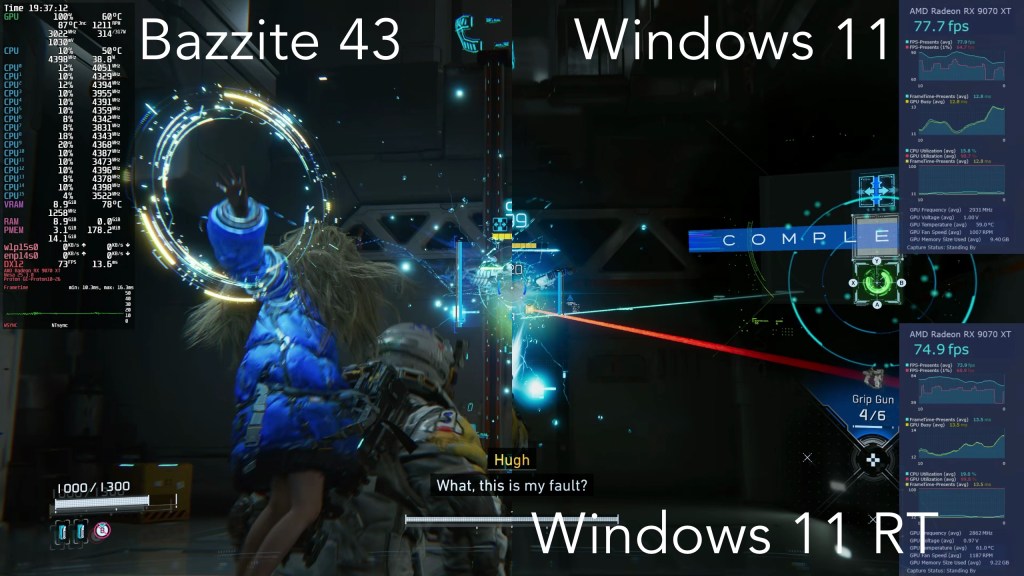
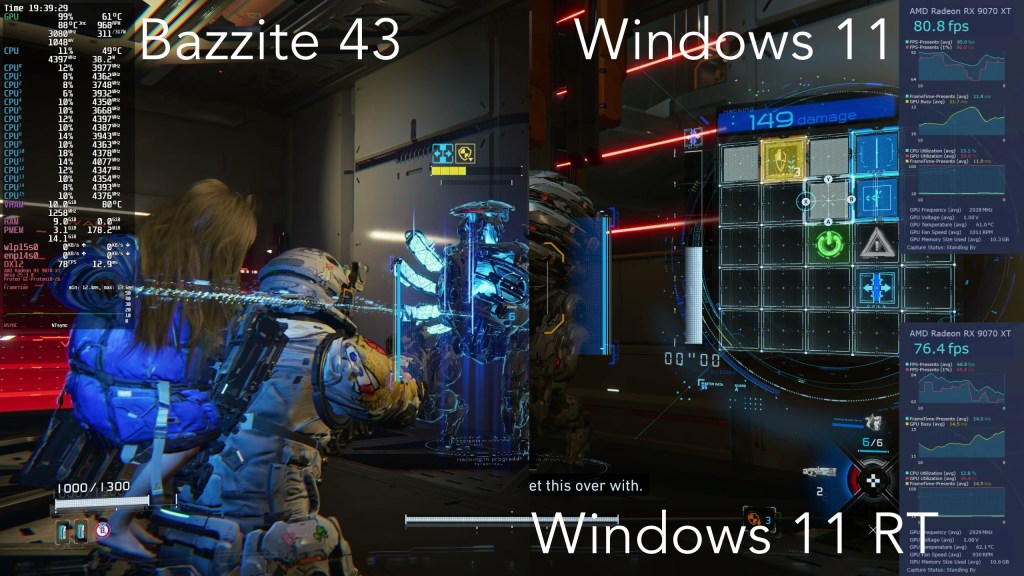

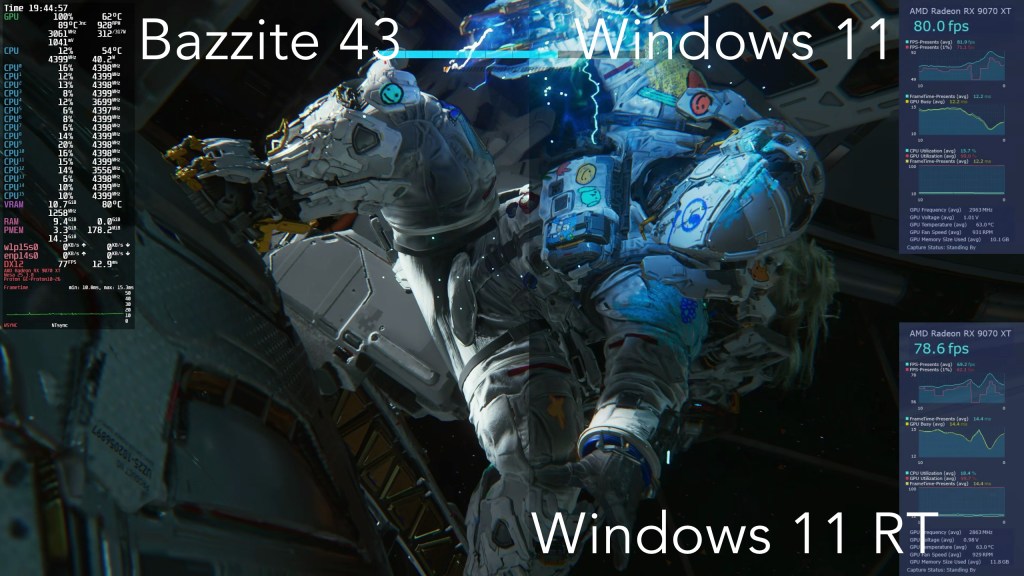
So, the numbers are compelling, but what about the mission we’ve been sent on?
Famous Last Words
Even after the demo, the story remains a mystery. We’re on a space station, and our goal is to restore communication with Earth. An unknown event turned all androids against humans, and they now attack on sight. Why? Remains a mystery. I didn’t encounter any NPCs, and whether other humans are still alive also remains a secret.
Just like the little Android girl. Her presence raises sooo many questions. Why does she resemble a human while the other Androids are clearly just walking toasters? Why a little girl? Why are we carrying her on our back? Too much inspiration from Cal and BD1? Honestly, the girl is a well of weird vibes. I found this most notable during the boss fight when the Overdrive feature was introduced.
On top of that, she’s quite the chatterbox. Horizon’s Aloy almost pales in comparison. The girl comments and explains nearly every item you pick up, even if you’ve already found one earlier. And she does that in an exaggerated, child-like girlish voice.
Looking back, I found the gameplay loop entertaining. However, I have doubts that it would immerse me for 10, 20, or more hours. After all, this hacking mini-game interrupts every exchange of bullets.
The demo took me about 20–25 minutes during my first playthrough, making it a very short experience. Each subsequent run of my performance tests took only about 10 minutes.
Thanks for spending your time with me today. Have a good morning, afternoon, or evening wherever you are on the globe.
 The Codeslinger