
Compulsion Games and striking art might as well be synonyms in dictionaries. South of Midnight’s visual identity is unmistakable, but it does not stop there. The game is more than just artsy graphics.
But before I briefly share my opinion on the game, let me talk about the technical side of things, which is central to this blog post. The primary focus is how South of Midnight performs on Linux and Windows, how difficult it was to get working, and things I noticed while playing on both platforms.
The Nerdy Bits
I purchased the game on Steam, and as one has come to expect, it just worked. I did not force any Proton version and let Steam do its thing instead. Throughout my playtime, I did not have any issues whatsoever. South of Midnight felt like it belonged.
Benchmarking Preamble
I tested on my AMD Ryzen 7600 with 32 GB of DDR5 6000 Mt/s memory and an AMD Radeon RX 7900 XT. Windows 11 was on version 24H2. My Linux installation was a regular Fedora 41 Workstation with Gnome Shell on Wayland running kernel version 6.13.9. Since I play at 1440p, that was the only resolution I tested. For graphics settings, I limited myself to Ultra and Very High at native resolution.
I ran every benchmark pass three times in one go instead of performing three separate runs and averaging the numbers.
Let The Numbers Do The Talking
I tested two locations in the game. One contained a combat sequence in addition to the customary loop, and the other just ran a loop around an abandoned settlement.
I uploaded a YouTube video that includes the complete content of this blog post paired with gameplay footage and the benchmark passes I used to obtain the following numbers.
| (1% / Average) | Village & Combat | Abandoned Settlement | ||
| Windows | Linux | Windows | Linux | |
| Ultra | 61.4 / 102.5 | 53.5 / 94.4 | 61.5 / 102.3 | 51.3 / 87.9 |
| Very High | 90.3 / 152.5 | 97.8 / 153.7 | 89.3 / 140.4 | 100.6 / 148.3 |
The results are fascinating. Using the Ultra quality setting, Windows has a sizeable lead in both scenarios. The 1%-lows are 14.7% and 19.8% in Windows’ favor, and in the average values, Windows leads by 8.5% and 16.3%. When I lowered the quality setting to Very High, the turns tabled, and suddenly, Linux was ahead of Windows. The lead was not as substantial as Windows’ dominance at Ultra quality settings, but 8.3% and 12.6% in the 1%-lows and 0.7% and 5.6% in the average FPS department are more than nothing.
I have not dug into this to find a reason. My assumption would be the typical behavior I have noticed in all the titles I have tested so far. Under higher CPU load, which the Ultra quality setting probably produces, Linux still has some issues. South of Midnight is light enough for this discrepancy not to be higher and very much tolerable. Nevertheless, I played on Very High and enjoyed a high-refresh-rate gaming experience.
Benchmarking Afterword
Please note that my results are based on an unmodified standard desktop Linux distribution without any tweaks. I am testing the default experience out-of-the-box of a general-purpose installation. Gaming-focused distributions like the long-awaited SteamOS or community-driven variants like Bazzite may have optimizations that skew the results in another direction. Using an NVIDIA graphics card might also produce wildly different numbers.
Thoughts On The Game
I was unfamiliar with Compulsion Games’ prior work, so I am uncertain about the general sentiment toward their titles. From the reviews I watched, I knew they all had a unique visual identity. What drew me to South of Midnight had nothing to do with the art direction or potentially positive past experiences. It was its narrative focus, uncomplicated gameplay, manageable runtime, and its reasonable price of 40€.
I am happy to say that I was not disappointed.
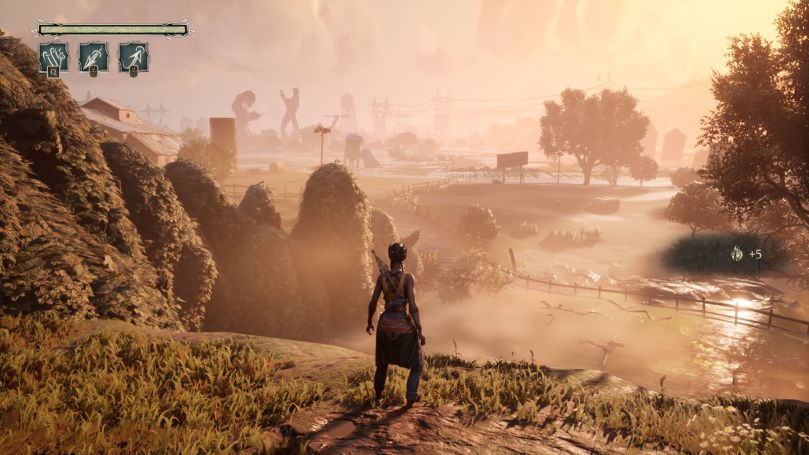
South of Midnight’s gameplay structure was simple: run through a variation of a corridor, enter an arena, defeat all monsters, move to the next area, discover story-related things, and repeat. This loop did not overstay its welcome, thanks to the short runtime of around 12 hours. It also allowed me to learn the game’s movement and combat to a degree that empowered me. And do not mistake this for easy combat. Enemies hit hard.
Combat is really the only aspect about which I have complaints. Some animations took away my control for too long, something I always dislike in any game, especially in a fight when there is a sense of urgency. The other issue concerned the precision of the main character’s strikes. I often missed enemies directly in front of me because attacks constantly moved the character forward, like skating on ice, which made me move and punch past the ugly monsters. It is a minor grievance that might not even happen when you lock on to enemies. I played with a keyboard and a mouse, though, and did not require an enemy lock. And even with a gamepad, I prefer not to have them.
The show’s real stars were the characters, the setting, and the absolutely flawless presentation of both. And I do not mean the art style – although it was very striking and befitting of the game. The design of the locations and the background music formed this cohesive and enticing adventure I could not put down. And it wasn’t just the background music. The main character’s movement was accentuated by vocals that might as well have been part of the background music – it blended so nicely. Stringing together moves like double jumps or glides resulted in various vocal accents, not just the same sound over and over. I found small details like this incredibly exciting and often just jumped around for that reason. Progressing further through a level layered more music and vocals on top of each other to form a more formidable sound stage.

The special thing about the music was the story context. Games with vocal tracks on repeat can get on my nerves quickly. I remember Stellar Blade being in that category. Not so in South of Midnight. Vocal tracks were implemented in a much more innovative way, and they directly referenced the currently active main story events. Because of this, the narrative was so much more emotional and elevated the whole experience. Which also included the voice cast, of course. They all were so excellently picked to fit the setting and did a phenomenal job. I heard from a buddy who played the German version on an Xbox that there wasn’t even a German audio track. English or nothing. I could not imagine a suboptimal German translation and voice-over doing South of Midnight justice. It would have ruined the game more than any other title.
As I already alluded to, the gameplay loop was just a vehicle to pace the game and string together the individual story elements. Levels were beautiful and interesting variations of corridors built in a way that appeared enormous in scope visually but only allowed a little exploration to find resources for level-ups. The world was conceptually big, and the distance traveled substantial, but it was a very guided adventure. And it was a good thing. A bigger world to explore would have only muddied the tight experience of the story.
Famous Last Words
South of Midnight was a technically sound game that ran extraordinarily well on any operating system I tested. Loading times were quick enough, performance was high, and stuttering was a non-issue. Windows performed better at the Ultra quality preset, but using Ultra quality as the default is generally a bad idea – unless you pay for that privilege in hardware. One preset lower often looks nearly identical and performs better. In the case of South of Midnight, it turned the game into a genuine, high-refresh-rate affair that felt awesome to play.
I also did not encounter any visual artifacts due to the Proton emulation. The game looked indistinguishable on Linux and Windows.
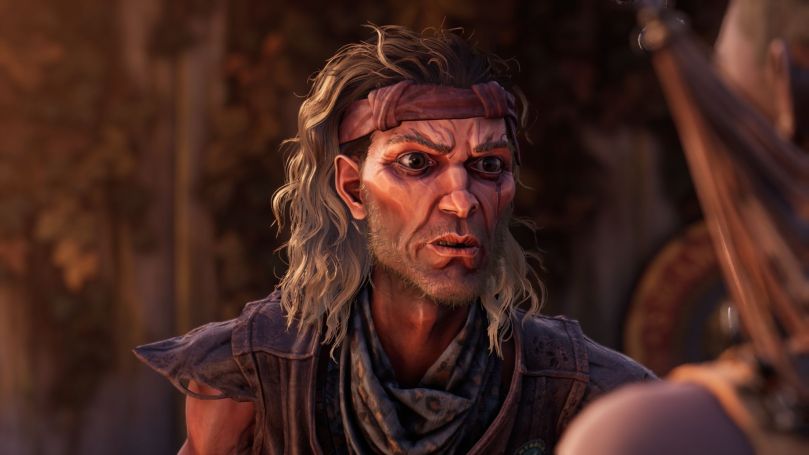
Besides the technical aspects, I also greatly enjoyed the game as a whole. The story was engaging, albeit a sad one. The masterful presentation and the main character’s progression carried it from start to finish. It wasn’t about twists and turns and plotting intrigues. It was about people, emotional trauma, loss, and developing empathy and understanding for others.
Looking past the approachable and straightforward gameplay, South of Midnight is a work of art because of its many other aspects.
Thank you for reading.
 The Codeslinger
[…] you enjoy American deep-south folklore, I have a Linux vs. Windows benchmark and review blog post, as well as a YouTube […]
LikeLike