Star Wars Outlaws is Ubisoft’s take on a Star Wars game working within the framework of their established Open-World formula. Although Massive Entertainment worked to avoid the checklist-like map design full of question marks, it still ended up being a checklist, just not on the map. And underneath all that busywork is a heist story along the lines of Ocean’s 11. With a twist.
But before I briefly share my opinions on the game itself, let me talk about the technical side of things, which is at the center of this blog post. The main focus is how Star Wars Outlaws performs on Linux and Windows, how difficult it was to get working, and things I noticed while playing on both platforms.
The Nerdy Bits
Let me start with the installation. I purchased the game on Ubisoft’s platform instead of Steam, so I had to resort to Lutris for the first step. After I installed the Ubisoft Connect launcher via this handy script, the procedure was the same as on Windows: select the game to install, the install location, and start the download.
In Lutris’ settings, I chose Proton-GE as the runtime, but I also tried Wine and Proton Experimental. Since I noticed no differences, I stuck with what I tested last, which was Proton-GE.
Benchmarking Preamble
I tested on my AMD Ryzen 7600 with 32 GB of DDR5 6000 Mt/s memory and an AMD Radeon RX 7900 XT. Windows 11 was on version 24H2 as of the end of March. My Linux installation was a regular Fedora 41 Workstation with Gnome Shell on Wayland running kernel version 6.13.8. Since I play at 1440p, that was the only resolution I tested. For graphics settings, I limited myself to Ultra and High, each at native resolution and upscaling with FSR Ultra Quality.
I ran every benchmark pass three times in one go instead of performing three separate runs and averaging the numbers. I am lazy, and I also assume that the result would be the same.
Let The Numbers Do The Talking
I tested two locations on the first planet, Toshara. One pass is a run from the Mirogana entrance to the market and back. This area is very CPU and GPU-heavy. The second location is a ride on the speeder from Jaunta’s Hope toward Mirogana and back. The CPU load is slightly lower, but the environment streaming system is hard at work at these higher traversal speeds in the Open World.
I uploaded a YouTube video that includes the complete content of this blog post paired with gameplay footage and the benchmark passes I used to obtain the following numbers.
| (1% / Average) | Mirogana | Speeder Run | ||
| Windows | Linux | Windows | Linux | |
| Ultra Native | 48.9 / 57.0 | 42.7 / 59.9 | 44.6 / 49.9 | 24.3 / 51.8 |
| Ultra FSR UQ | 58.4 / 69.3 | 46.4 / 69.0 | 49.8 / 56.6 | 28.4 / 59.0 |
| High Native | 59.6 / 73.7 | 47.7 / 74.6 | 53.2 / 61.2 | 31.6 / 66.2 |
| High FSR UQ | 60.6 / 82.0 | 48.6 / 78.1 | 59.1 / 70.7 | 35.7 / 72.7 |
The benchmark results prove what I was feeling during gameplay. While Linux can match Windows in peak performance, it trails behind in consistency.
The benchmark results prove what I was feeling during gameplay. While Linux can match Windows in peak performance, it trails behind in consistency.
As you can see in the Mirogana numbers, the amount of performance gained from Ultra quality at native resolution to High quality with FSR upscaling is just six fps on Linux. Windows gains almost 12 fps. 12 fps is also the difference between Linux and Windows at the most performant 1%-low settings. Linux clearly runs into a limitation here.

The difference is even more stark during the speeder run in the Open World. Linux gets crushed by Windows in the 1%-low department. There is constant stuttering, which is also visible in the video’s frame-time graph.
And this is a trend I have noticed several times comparing both platforms in different games.
Despite that, please note that these two samples are worst-case scenarios. I saw no issues during missions. Sneaking through small camps, large bases, or heated shootouts runs smoothly at high and consistent framerates. Whether this inconsistent performance may affect you depends on how much time you spend exploring the bigger cities and roaming the Open World. It is playable overall, and a VRR display will hide some of it. The numbers look bad, but if you refuse to use Windows, the experience is fine enough to have fun.
I did not find any difference in loading times between both platforms. The game thinks it is running on a spinning drive on Linux, but it does not affect loading into the game or using fast travel.
Assorted Findings
Apart from a single finding, Linux and Windows appeared to display the same image. There were a few circumstances where Linux rendered oddly blinking artifacts in darker environments. On Kijimi, it was the snow hitting the main character. But I also noticed this in the loadout menu and indoor environments on a sand planet. Fat chance of seeing snow there.
Thoughts On The Game
The game attempts to immerse you into the underworld of the Star Wars universe, and it does a good job of that. Much of the side content revolves around robbing people blind, irrespective of who it is. The people do not matter; there is only treasure to loot. And this is where Star Wars Outlaws feels like any other recent Ubisoft game. You go to the location, explore it to find the treasure boxes, and move on to the next piece of intel.
(Which is just another item on your journal checklist)
How you obtain information about where to go for thievery is nicely done. You acquire locations from data-pads found in the world or eavesdropping on conversations from NPCs. It’s more natural than a question mark on the map.
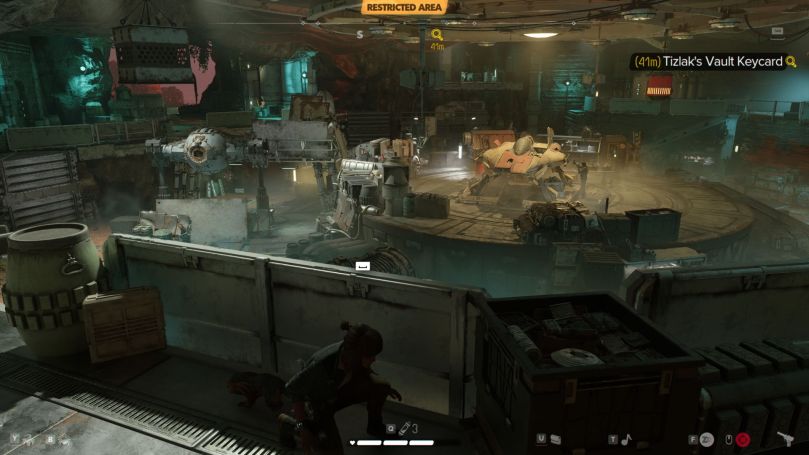
Between the brainless activities, you perform actual missions. Unfortunately, the main story starts slowly. It became more interesting once I unlocked the first permanent crew member of my Ocean’s 11 gang. The boost in engagement resulted from more frequent radio chatter and the character development that came with it. That was when the game picked up for me. I found all the side missions uninteresting and pointless. The content was rooted in the universe and the overarching theme – “scoundralism”. What I found missing was a purpose other than spending more time in the game. I played Star Wars Outlaws while watching a streamer enjoy Kingdom Come Deliverance 2 (not simultaneously). There is such an enormous gulf between a KCD2 side mission and Star Wars Outlaws. Missions in KCD2 make you feel something because they focus on characters and interesting stories. That was the secret sauce missing in Star Wars Outlaws. I did not care about what happened in the side missions, so I stopped engaging with them. The main story, on the other hand, was well done. The final missions had a few interesting twists, and the end was satisfying.

Satisfying is not a word I would pick to describe the Open World – or space combat. As great as it looked, something prevented me from enjoying it. To provide some context, I enjoyed Assassin’s Creed Odyssey a lot. I discovered every question mark, looted every location I could find, and had much fun doing so. Star Wars Outlaws tried to do the same thing in a different universe with different tools. But somehow, it did not work for me. I enjoyed sneaking through enemy hideouts and silently eliminating everyone far less than in ACO.
Additionally, Star Wars Outlaws made me visit the same place multiple times for different reasons. There was this one particular hideout that I went through three or four times. Once, on my own volition during exploration, and other times, it came from intel about treasure and side content. This part of the game design also took the wind out of my exploration sails. Why waste time looking around to find things when you are sent to these places anyway?
Being the first Open World Star Wars game was not the right goal for Star Wars Outlaws. I believe a focused linear story with a few smaller areas to explore and high-quality content would have made a better game. You can play it this way by ignoring everything besides the main story, and after about twenty hours, I did precisely that. The game has many great missions and amazing locations. Like most modern titles, you can scramble around like Lara Croft, sneak and silently take out enemies, and get into a shootout with gangsters and the Empire. If only there were a more significant incentive to engage in the Open World activities.
Star Wars Outlaws is not a good buy at full price, even if this statement goes against what I contemplated in a previous blog post about full price vs. discounts. For me, 30 – 40 bucks is a fair deal for the main story and some experimentation with the game mechanics.
Famous Last Words
Looking at the tech only, Star Wars Outlaws looks mostly outstanding – and I have not even seen the RTX Direct Lighting for myself yet. The game makes a few concessions, but it manages to run well on AMD’s less-capable ray tracing hardware. I always prefer a ray-traced global illumination system over shadows or reflections. Good lighting and ambient shadowing profoundly affect the visuals, and Star Wars Outlaws shines in that aspect. Nevertheless, I’d like to dunk on the reflection quality. If your hardware can handle it, increase the Specular Reflection Resolution to Very High. I also think water looks less like water and more like slimy oil. Unless that was the intent?
I liked the Ultra Quality upscaling option, though. Very few games do this, and usually, the highest quality option is Quality, which, for FSR, is rather unsuitable below a 4K resolution and only a last-resort option.
Linux performance sadly is a mixed bag. Large settlements and the Open World traversal suffer from frequent hitching. Performance is generally good when traversal slows down or you engage with missions. Overall, it is playable enough, and I spent about half of my 30 hours on Linux. I did prefer Windows, though.
If you ask me about the game itself, I recommend it with a few caveats. It is a well-made game, and the Star Wars atmosphere is outstanding. However, for some reason, the Open World did not work as well for me as Assassin’s Creed Odyssey did. It is the same concept in a different universe. There is so much more to discuss about Star Wars Outlaws, but I think there are other, better reviewers out there, like Skill Up.

On a closing note: Kay’s little companion Nix is the cutest, and I enjoyed their relationship. It is like Cal Kestis and BD-1. There’s even something like a “loyalty-mission”, one of the most emotional moments in the game.
Thank you for reading.
 The Codeslinger
[…] you’re a space-faring scoundrel, I have a Linux vs. Windows benchmark and review blog post, as well as a YouTube […]
LikeLike